


In my April insider update, I spoke about the winners and losers in the trade wars (for which the jury is still out, but I stand by my views), and about agentic AI. Since then, I’ve devoted extra time honing one of our pillars of investing which is our thesis around the Future of Work and AI.
Like most other astute observers of the rapid rise of AI, my partners and I see the profound potential for the positive impact on businesses and society as a whole, along with unfathomable risks created by unbridled AI diffusion into everything we see, hear, and do.
My work with Capria, combined with my continued interviews for the book I’m co-authoring, Flourishing with AI, has led me to connect with leaders and thinkers from all walks of life. Over the past several months, I’ve spoken with the head of a university art department dealing with student revolt against AI, a member of Parliament in Singapore, dozens of startup founders, corporate business leaders, a Google “10x engineer”, venture capital managing partners, an AI-adopting star middle school teacher, recent high school and college grads deeply concerned about getting jobs, and more. The verdict? AI is moving too fast, and we are adopting too slowly..
Why too fast and too slow?
You can read numerous authors and pundits speaking to the deep concerns about the speed of AI adoption being faster than society can manage. If you want to get deep into the risks of the AI supremacy race between USA and China, read the recently released (April 2025) scenarios developed by the AI 2027 group, here. More than two years ago, the statement issued by the Center for AI Safety stated “Mitigating the risk of extinction from AI should be a global priority alongside other societal-scale risks such as pandemics and nuclear war.” The letter was signed by luminaries including Sam Altman, Bill Gates, Geffory Hinton, and more.
Frankly, little has changed at the policy level. The AI supremacy war between the USA and China combined with Silicon Valley’s approach to “move fast and break things and let the lawyers clean that up later” is likely to subvert any attempts to regulate or contain actions anywhere that matters. I offer no solutions to this problem — it’s here to stay; at least for now. We can only hope that some AI naysayers like Gary Marcus are correct in stating that artificial general intelligence and super-intelligence will never be achieved with current LLM technology. His recent article “Generative AI’s crippling and widespread failure to include robust models of the world” makes this point very convincingly.
Why then am I concerned about “too slow” when use of ChatGPT has grown from near zero to 1.1 billion users per week in 2.5 years? Simply put, despite all the problems current AI has, from energy consumption to hallucination to lack of real world models, it can already do amazing things to improve the productivity of individuals and businesses at an unprecedented scale. Judging by layoffs from giants including McKinsey, Microsoft and more, it’s already taking hold in early-adopting companies. Experimental evidence from the OECD shows that large organizations like Microsoft, Procter & Gamble, and BCG are rapidly integrating generative AI into core workflows — such as sales, product innovation, and consulting — with measurable gains including a 25% increase in task speed, 40% higher output quality and significantly improved performance in product development tasks.
Despite the cross-industry demonstrated value, take a look at this survey with counter-intuitive results on AI adoption in a Global South tech VC’s portfolio (not ours) of 50+ early-stage startups. You’ll see only 20% are actively using advanced AI. I had expected closer to 80%.
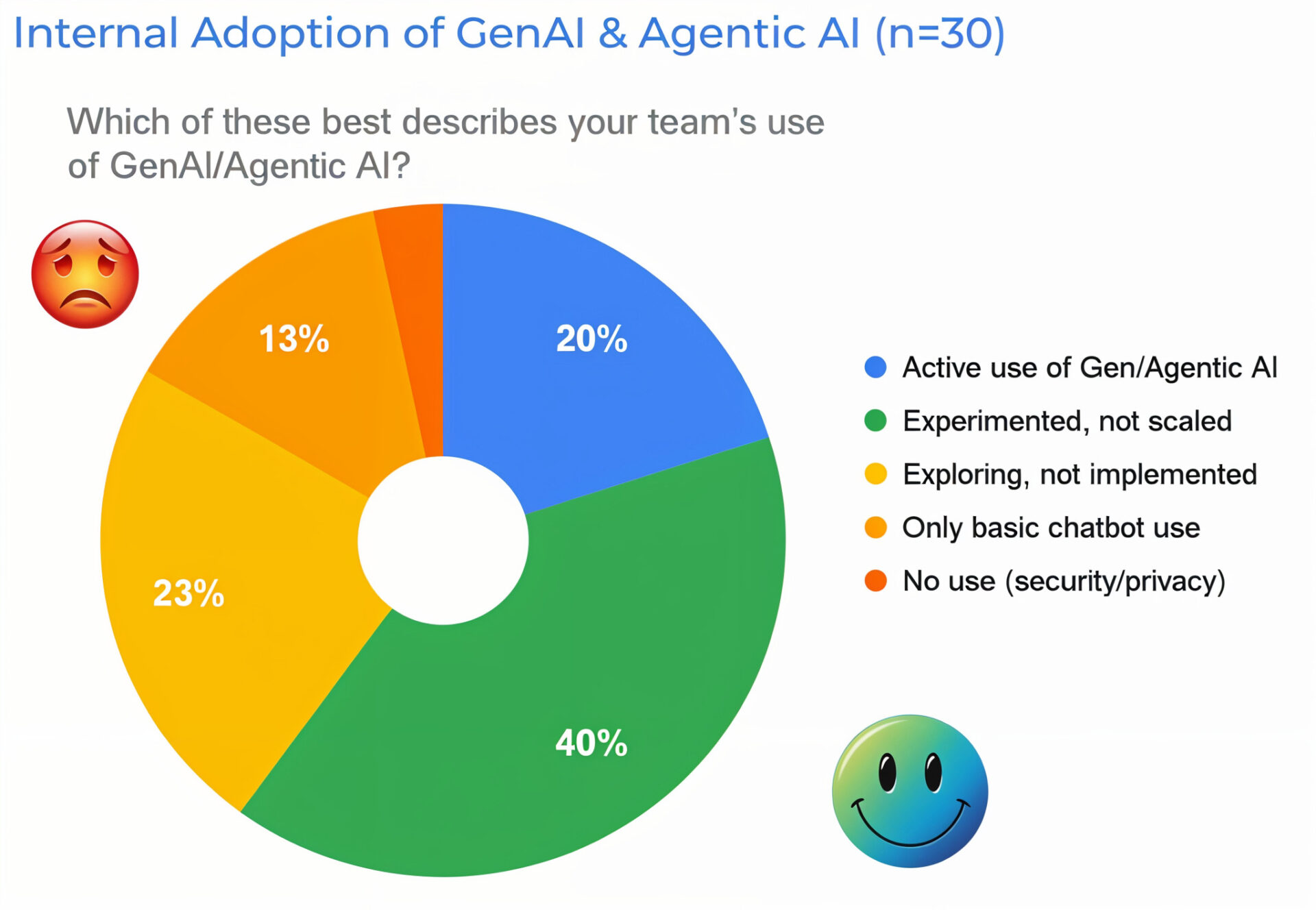
I find similar stories everywhere I go outside of the AI tech epicenters and the earliest-adopting companies. And while 1.1B users / week on chatbots sounds impressive, it’s less so when you consider that some 3.5B people own smartphones, and there is no cost to users to make use of LLMs. The spoken reasons of why people are slow to adopt AI is long:
- AI hallucinations and inaccuracy
- Data privacy and confidentiality
- Environmental impact
- Cybersecurity / deep fakes
- Over-reliance — AI replacing judgment
- Loss of human creativity and skills
- Lack of reliability and consistency
- Premature implementation risks
- Regulatory and compliance risks
I find the unspoken reasons more interesting, as all of above can be/is being addressed: Fear, Lack of trust, Resistance to change, Status quo bias, Incorrect perceptions, Too busy, Can’t keep up, Competency/training.
Some of these will be addressed by the natural pace of tech adoption, from early adopters to majority use to laggards. Don’t forget, it took 35 years to reach 1 billion PCs in use around the world, 20 years for 1 billion cell phones to be in use, and about 12 years for 1 billion smart-ish phones to be adopted. All of those required purchasing hardware and/or services; AI chatbots have zero barriers to adoption other than the spoken and unspoken issues enumerated above.
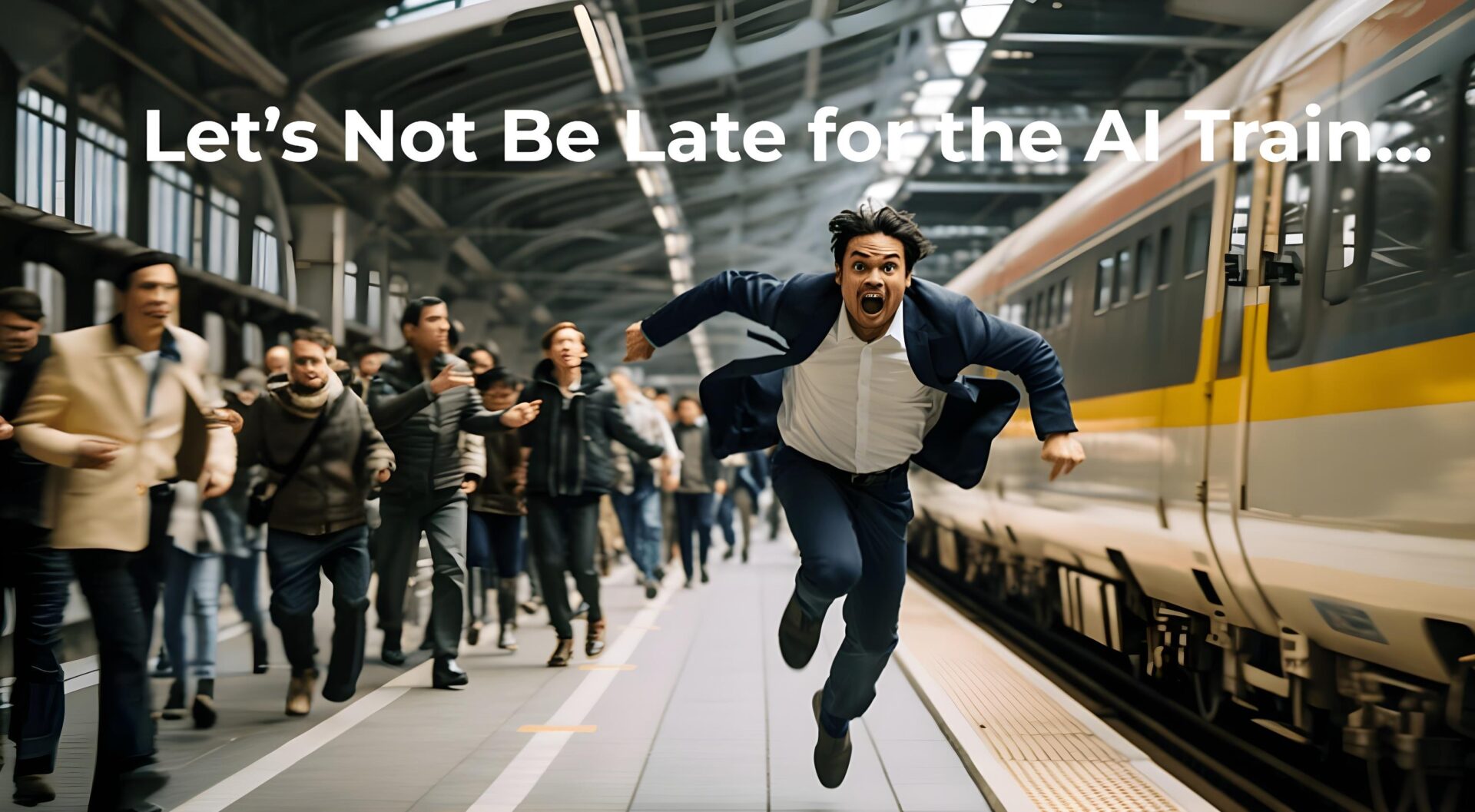
I’ve been making the point to founders from around the world and to anyone else who will listen that the imperative to bring AI into your life and work is here and now, and that those who wait risk “missing the AI train” and/or being outrun by their competitors who are embracing AI.
Getting back to my book, Flourishing with AI. Co-author Ravi Venkatesan and I aim to help individuals and managers overcome the spoken and unspoken barriers to AI adoption and to “Make AI their ally.” I invite you to take a look at a draft version of it, available via the chatbot tech that Capria develops to support our portfolio companies, here: https://jobbot.flourishingwith.ai/register/.
You can also listen to 5-15 minute podcasts discussing various topics in the book here: https://flourishingwith.ai/podcasts/.
I’m very interested in hearing from my readers about their personal or professional experiences with successful or unsuccessful AI implementations. Please drop me a note if you have some that might be relevant to our investment thesis or my book.
Our Portfolio and AI
We continue to unlock value in our portfolio by helping them accelerate their AI journey (see how, here) and to find new companies to invest in that are “AI-all-in” and/or “AI-first” across the Global South. Referrals always appreciated.