
It’s hard to miss the rollercoaster of AI-fueled public and private valuations. GenAI is hailed as the future one minute, and the next, it’s dismissed as overhyped and unable to deliver an ROI on the $B being invested. Then, word gets out about OpenAI raising a round at a $100B valuation. These wild swings can be unnerving, especially when your investment strategy is caught in the turbulence. The recent crash, subsequent partial recovery, and continued volatility of the “Magnificent Seven” only add to this sense of instability. While public markets are not our focus, such volatility has widespread implications across private and public strategies alike…
My more in-depth thoughts on the hype cycle follow. I also have been posting short videos on current topics every ~2 weeks – you can find them here.
From the Peak of Expectations to the Trough of Disillusionment and Back
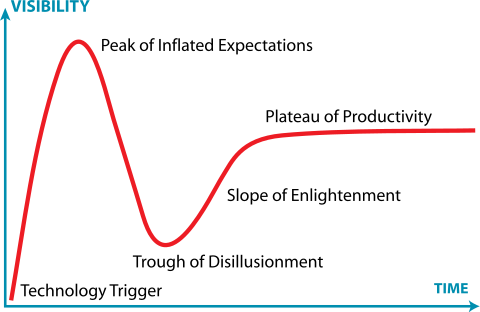
To understand where AI stands today, revisiting Gartner’s hype cycle is useful. This framework outlines the typical stages new technologies go through, from initial excitement, inflated expectations, disillusionment, and finally, a stable period of productivity. AI is currently navigating this familiar cycle, arguably with a mix of high expectations and challenges, as it starts finding its place in everyday use.
Consider the media frenzy around ChatGPT 3.5, which sparked visions of AI-driven utopias and fears of mass unemployment. Now, as the initial excitement wanes, reality is setting in. We’ve seen this pattern before with technologies, including the internet in the 1990s, solar power before ~10 years ago, and even railways back before most of us were born — overhyped initially, then undervalued, before eventually becoming mainstream. AI is now entering the “trough of disillusionment,” where expectations are being recalibrated again – this is at least the 3rd time, and there are more to come. But I believe the data show that its true potential is becoming clearer. This stage is natural for any advanced technology to mature and deliver sustained productivity and value.
While consumer-focused AI like ChatGPT sparked both excitement and hand-wringing doubts about the future, the real action is happening in enterprise use cases, where GenAI is quietly transforming productivity and business operations. Across sectors, companies are finding real-world applications for GenAI that go beyond the hype. Goldman Sachs, for instance, leverages its GS AI platform to handle over 100,000 daily transactions with data privacy and minimal errors. This example, along with Amazon’s cloud business being supercharged by GenAI (which I discussed in a previous newsletter), points to a broader trend of enterprise adoption taking hold, offering measurable ROI and meaningful digital transformation. Even massive consulting companies like BCG and McKinsey are aggressively adopting GenAI for internal use, signaling its real-world value.
Back to You, and to Our Startups
As the dust settles from the hype dominated by OpenAI, we’re seeing the emergence of no fewer than five comparable LLMs — deep foundation models from OpenAI, Google, Anthropic, Meta, and X.AI — that are shaping the next wave of AI-driven innovation in different ways. You’ve undoubtedly used ChatGPT, but I would not be surprised if you have not done more than sample one other. I find that frequently in discussions with busy people. I highly recommend giving each of them a decent trial period, as there is material differentiation depending on what you do. A great use case for investors or business executives is to treat the LLM as a “thought partner,” as described very well in Scott Galloway’s recent newsletter. The results will impress you.
As applied AI consumers of this tech, our startups are in a chaotic but very good place, as the foundation model giants are already fighting for market share, dropping API costs, extending credits, and adding multi-modal support, all while innovating in model performance and reasoning capability. This broader enterprise adoption mirrors what we’re seeing in our own portfolio companies. For example, BetterPlace is already integrating GenAI into its services with its new training module generator for frontline workers. BetterPlace’s GenAI-driven module offers text-to-course generation in multiple local languages, now available to large enterprise customers like Reliance and Swiggy, who collectively manage millions of frontline staff. This example illustrates that, despite the current skepticism surrounding AI, scaled startups are using the technology to deliver real-world solutions. No disillusionment here — just innovation and adoption where it matters most.
The Road Ahead: Ignore the Noise
So, where does all this leave us? As these examples show, the disillusionment phase doesn’t mean GenAI isn’t delivering value—it simply requires a longer-term perspective. Despite the media narrative, companies and investors who understand this are poised to reap the rewards. From a mainstream perspective, we’re in the trough, and the skeptics are having their day. But if history is any guide, this is the time to pay attention. McKinsey’s research estimates that generative AI could add between $2.6 trillion and $4.4 trillion annually across 63 use cases. ChatGPT now has a million business users, up from 600k three months ago. Capgemini’s recent study showed a 7.8% boost in productivity and a 6.7% increase in customer engagement, all thanks to AI. These productivity advances have not been seen since the heydays of enterprise PC deployment.
My take
GenAI’s enterprise value is becoming clear, even as we navigate the “trough of disillusionment.” The long-term trend is undeniable—incumbents and VCs alike are continuing to invest. Supporting this point, OpenAI co-founder Ilya Sutskever’s 3-month-old startup Safe Superintelligence just raised $1 billion from prominent venture capital names in Silicon Valley, including Andreessen Horowitz and Sequoia Capital. Clearly, not everyone is wallowing in that trough—far from it. Those who recognize the underlying value are moving forward decisively.