

Three years after ChatGPT’s public debut, the narrative around LLMs feels very different. The technology is still astonishingly useful (even more so than many people realize, which is one of the motivations for my upcoming book, “Flourishing with AI”), but the story investors told themselves about capex, adoption, and AGI is in dispute. When I wrote “The AI Bubble Burst: Triggers and Winners” in October, I argued that timing was unknowable, but the imbalance between spending and realized value was already uncomfortable, and that we are in “bubble territory”. That concern has only widened in the past weeks. At the same time, job evaporation concerns have been somewhat mitigated, and the promise of generative and agentic AI as a useful tool in vertical markets as well as general-purpose horizontal areas continues to unfold nicely. And Capria’s applied AI investment thesis is as exciting as ever from our unbiased perspective, as the startups making effective use of AI continue to be born, the ones we select are bubble resilient, and growth post-investment is faster than ever, consuming less capital than ever. Illustrating the final point, we just approved a term sheet to sell one of the best AI companies in our previous India fund. Presuming it closes, the sale will propel the fund to be ranked in the top 5% of early-stage funds of its vintage (based on the June 2025 Cambridge Associates EM VC report).
With the benefit of three years of breakneck innovation and experimentation, it’s apparent that AI’s practical gains are arriving unevenly while the mass media and industry leaders’ narratives around jobs, infrastructure spending, and AGI drift farther from reality, making this 3rd birthday a timely moment to separate what’s truly working from what AI infrastructure developers only hoped would work. Here are my thoughts, starting with some temporarily good news.
1. Jobs: A slower shift, with real tail risk
The best current snapshot of AI and employment comes from the Yale Budget Lab’s October paper “Evaluating the Impact of AI on the Labor Market: Current State of Affairs.” Using U.S. data for the 33 months since ChatGPT’s release, the authors find no “discernible disruption” in the overall labor market so far, and that measures of AI exposure, automation, and augmentation show no systematic relationship with changes in employment or unemployment. Coverage in outlets like The Guardian and Workplace Insight emphasizes a key point: jobs that are theoretically “AI-exposed” have not yet lost employment share relative to less exposed occupations. Both sides of the U.S. job market look equally soft, driven more by macro conditions than by robots eating white-collar work. At the same time, my interviews researching topics for Flourishing with AI with senior industry leaders, combined with Capria’s experience from our investment portfolio, indicate that the shift is unquestionably starting. We’ve identified a variety of industries in which hiring is slowing dramatically due to AI-driven efficiency. And the most recent unemployment data in the U.S. of recent college graduates is at the highest level in 10 years (excluding the pandemic). The anecdotal and leading indicators are clear, while some macro indicators lag.
At the same time, Geoffrey Hinton and others focused on AI policy are trying hard to keep CEOs from drawing the wrong conclusion from this macro lull. In a recent Georgetown conversation with Bernie Sanders, reported by Business Insider as “The godfather of AI doesn’t think CEOs have thought about one big thing that could happen if AI kills most jobs,” Hinton said he believes forecasts that AI could wipe out roughly half of entry-level white-collar roles are “probably right.” His core warning: many CEOs and investors have not thought through what happens when a technology that can replace cognitive labor improves rapidly in a demand-constrained economy. If workers don’t get paid, they can’t buy the products, and the result is social and economic instability, not just margin expansion.

So the macro and anecdotal data tell us we were wrong about the speed of job displacement, but likely are right about its probability, with severity still to be determined. For now, AI looks more like a slower-than-predicted-burn general-purpose technology than a sudden labor apocalypse. But if Hinton is even directionally right about the medium- and long-term trajectory, boards and policymakers who wait for the unemployment statistics to move before acting will be very late to a difficult challenge.
2. Capital: Rising capex, rising bubble risk
The spending curve is still going nearly straight up. Since my October bubble note, new estimates suggest that Microsoft, Amazon, Alphabet, and Meta together will spend roughly $350 billion on infrastructure in 2025, most of it AI-related, according to Reuters. Bank of America now pegs 2025 capex for the big four at about $344 billion, or 1.1% of U.S. GDP, up from $228 billion last year, as summarized by AI Magazine.
On the revenue side, the math still looks ugly. Building on work by Harris Kupperman and others, analyses like this piece in Firstlinks argue that simply covering the 2025 build-out may require $320–480 billion of annual AI revenue, not “someday” revenue. That is an extraordinary bar, given that most AI usage is either bundled into broader products or effectively free to end users. The shining star of the revenue << costs is, of course, OpenAI, which on December 2 declared a “Code Red” due to Gemini 3’s apparent superiority.
Meanwhile, the data keeps saying adoption is racing ahead of ROI. McKinsey’s 2025 “State of AI” survey finds that around 88% of organizations now use AI in at least one function, but only 39% report any EBIT impact, and most of those say AI accounts for less than 5% of profits, with nearly two-thirds admitting they have not begun scaling beyond pilots. (The McKinsey report is long but a good read). A parallel 2025 study from Boston Consulting Group covering more than 1,250 firms concludes that just 5% are getting measurable financial value from AI while about 60% have seen little or none. Gartner expects at least 30% of generative AI projects to be abandoned after proof of concept by the end of 2025, and CIO Dive’s summary of Gartner’s latest numbers notes that even as GenAI spending is forecast to jump 76% year over year to $644 billion, many CIOs are quietly culling internal pilots before they ever hit production. You’ve probably read the well-circulated MIT study so I won’t requote it. A recent Economist article recounts even more such studies. Taken together, this looks less like a smooth enterprise rollout than leaders predicted. But at the same time, it’s not an uncommon pattern of past IT roll-outs. That’s why the Gartner Hype Cycle was introduced in 1995 :)
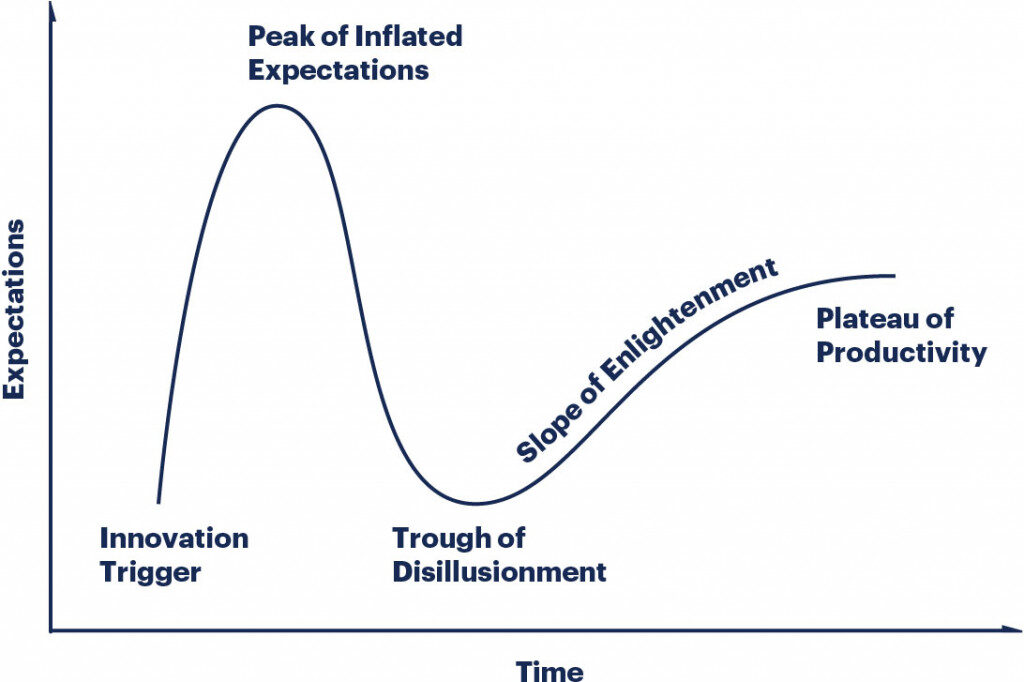
Layered on top of the hype cycle challenges is growing algorithmic risk. On December 2nd, DeepSeek dropped version 3.2 that they claim to be comparable to the latest GPT 5 release from OpenAI, operating at a fraction of the cost and also available open source. What does “fraction” mean? Their most advanced “Speciale” model is priced at $0.40 per million tokens, compared to GPT-5’s $10 / million (25x cheaper) and Gemini’s $12 (30x cheaper).
Yann LeCun, one of the Turing Award “godfathers” of deep learning, has been increasingly blunt that today’s LLMs are “not a path to human-level intelligence” and are “sucking the air out of the room,” as reported by Business Insider. In late November, he announced he is leaving Meta to found a new company focused on “Advanced Machine Intelligence” and world-model-style, physically grounded AI, described in more detail by Reuters and 36Kr.
If some of the most respected people in the field are publicly arguing that LLMs are a dead end for AGI and are now raising capital for alternative architectures, that increases the probability that a large chunk of today’s capex is pointed at the wrong technical stack. As I noted in October, Microsoft and Google and others with cash cow revenue streams will weather a correction just fine. Others, not so much. (We’ve all read the signals of OpenAI indicating they might ask for a US government bailout while at the same time engaging in suspect circular financing). Combine overbuild, slow enterprise monetization, and rising architectural uncertainty, and I’d say the odds of a non-linear re-pricing are meaningfully higher than when I published the October bubble piece.
3. Technology: LLMs as tools, not a near-term path to AGI
Gary Marcus, LLM curmudgeon extraordinaire, has just published a three-year retrospective, “Three years on, ChatGPT still isn’t what it was cracked up to be,” which is worth reading in full, whether or not you agree with him. It’s long, but informative, and full of references to others who back up his points. Stripping out the “I told you so,” his message is straightforward:
-
After three years, LLMs are still unreliable for tasks that demand robust reasoning, causal understanding, or high-stakes decision-making. Incremental releases have improved benchmarks, but have not eliminated hallucinations or brittleness,
-
Scaling data and compute has delivered diminishing returns. Bigger models talk more fluently, but they still lack grounded world models and struggle with multi-step planning and out-of-distribution situations.
-
As a result, Marcus argues that AGI should not be the central goal of AI research. Instead, he calls for focusing on targeted, verifiable tools, tighter evaluation, and architectures that combine learning with explicit representations and reasoning.
Crucially, this is no longer a fringe view. LeCun’s “dead end” critique of LLMs and his push toward world-model-based architectures, documented in 36Kr’s analysis, lines up with Marcus in one key respect: very few others than Sam Altman and Elon Musk, both repeat offenders on tech hyperbole and under-delivered promises, are saying “scale GPT-like systems another order of magnitude and you get AGI.” Even OpenAI co-founder Ilya Sutskever is quoted in the same piece as saying the “just add GPUs” era is over.

Taken together, these three threads point to an updated investor stance that’s guiding Capria’s thesis in India, Latin America, and Africa: keep betting on applied AI achieving real productivity gains, but assume that (1) the labor market impact will likely arrive later and more unevenly than the early hype suggested, creating many opportunities for startup founders to create value along the journey of change; (2) today’s capex curve will not be supported indefinitely, and (3) LLMs are a valuable but bounded tool rather than a straight line to AGI. Speaking of founders, see the “PS” below for a profile of two types of companies we think are most likely to thrive in this crazy new world that’s evolving with and around us.
Our India fund is open now with 8 exciting companies in the portfolio already. We’re gathering input from prospective investors for our next regional funds in LatAm and Africa. If you’d like to learn more, please reply as to which region(s) you are interested in.
PS: Two profiles of companies that I think will do exceptionally well in coming years:
1/ Vertical AI: With enterprises struggling to integrate generic LLMs into their existing, messy workflow, the real investment opportunity is not in the universal intelligence tool. It is in its surgical, targeted applications. This is Vertical AI. We believe targeted models built for specific use-cases will emerge as the true long-term winners when the infrastructure bubble pops. These are the businesses that will transform established business workflows and create tremendous value in the process. They solve a precise, hard problem. Founders will win when they know the problem space, and have proprietary access to enterprise data and/or customers who need the problem solved.
2/ Human-centric AI: The Silicon Valley is more focused on replacement of humans than augmentation of humans. Founders who start with a premise that their solutions have to be optimized for “human in the loop” scenarios, especially when those humans are doing logistically complicated messy things in the real world, will do well. Targeted AI solutions that amplify human capacity and allow companies to achieve exceptional results in both revenue generation and cost savings (with the emphasis on the former) will do well, regardless of the capex spending insanity of the foundation model developers.