Enterprise Resource Planning (ERP) systems are the heart of modern enterprise; they control the “blood flow” of businesses, from factory inventory to financial ledgers. Yet, business operations are heavily customized and constantly evolving, with flows in perpetual flux as they undergo regular updates, supplier reconfiguration, and shifting workflows. Managing this ever-changing landscape requires continuous oversight, with steady-state recurring validation across the Fortune 1,000 alone representing an estimated $65 billion annual market.
Moreover, risk drastically increases during major transformation projects, such as an ERP migration or a cloud switchover. During such events, a single corrupt entry can trigger factory downtime, freeze operational floors, and disrupt global supply chains.
The “Maker-Checker” Model
To de-risk these transformations, enterprises have developed the “Maker-Checker” model: system integrators (SIs) figure out how to codify the operations (the Maker), while testing teams validate that the code will not conflict with actual business operations (the Checker). In practice, however, this balance often blurs. The maker often ends up grading their own homework, letting gaps slip into production and causing delayed go-lives or post-migration errors. Failure to verify properly can have serious consequences. When Hershey botched its ERP cutover in 1999, shipping delays during peak Halloween season erased nearly 20% of its quarterly profits.
Enter Shamrock: The Context-Aware Checker
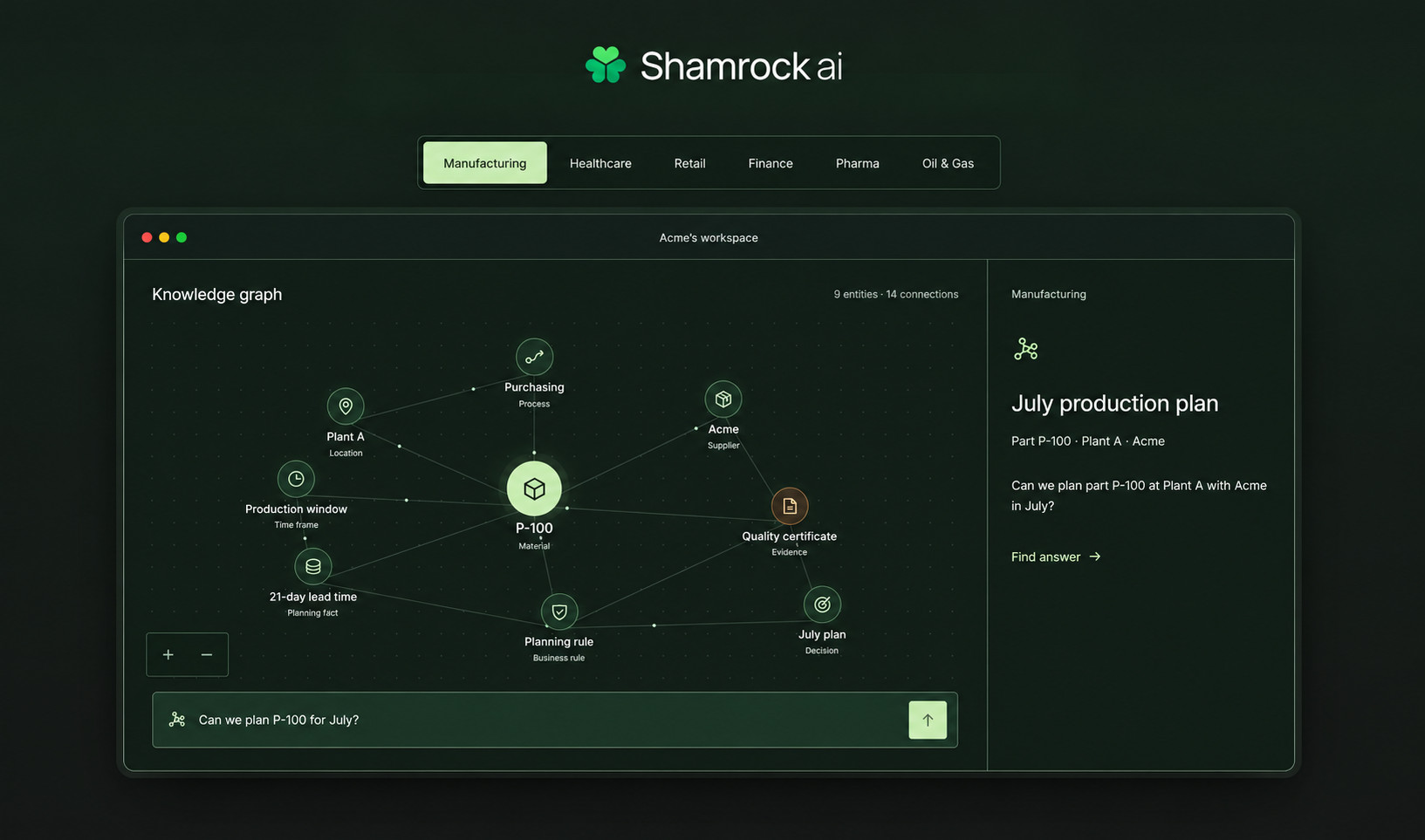
Shamrock assumes an AI-native “Checker” role by automating the process through a platform that replaces manual testing with agentic verification. Deployed within the customer’s secure perimeter, the platform automatically ingests up to 70% of core SAP configurations, custom metadata, and transaction histories. From this, Shamrock builds a Process-Aware Digital Twin, essentially a living model of the enterprise’s operational logic. Agents then continuously simulate transactions and stress-test workflows against edge cases at a scale human consulting teams cannot match.
While Shamrock is currently capturing the urgent budgets tied to the global wave of SAP S/4HANA migrations, its Context Spine extends far beyond one-off migrations. Once deployed, the digital twin becomes an evolving enterprise infrastructure, unlocking use cases such as continuous process automation, proactive supply chain optimization, and real-time data governance. Multiple enterprise customers are already running these ongoing operational workloads today.
Why We Invested in Shamrock
1. The Context Imperative in the Age of AI
The current wave of AI deployments is exposing a long-ignored flaw of corporate IT. They rest on rigid, codified structures that cannot capture tribal knowledge, fragmented business processes, or human workarounds. AI agents that ingest these legacy databases cannot build the context they need to be truly intelligent. Essentially, these agents work in the dark, relying on sparsely documented sheets as guidebooks, with no idea how real operations work. To make these “blind” agents work properly, they need an underlying architecture that captures operational flows and unifies them into a living context layer. Shamrock is providing this exact missing bridge between legacy ERP and agentic workflows.
2. Augmentation Over “Rip-and-Replace”
A prevailing narrative suggests that legacy enterprise software will soon be upended by “AI-native” challengers. But for Fortune 1,000 enterprises, uprooting deeply embedded software is a multi-hundred-million-dollar, operationally painful undertaking. When migration projects alone historically take three to five years, ripping and replacing systems of record is rarely viable. As the broader market has started to realize this friction, the dramatic narrative of an overnight “SaaSpocalypse” has also begun to cool.
So we chose a different approach: backing teams like Shamrock that augment existing systems rather than compete with or replace them. By operating directly underneath the software enterprises have built their business on, Shamrock can deliver immediate value without requiring architectural overhauls. This approach is one reason Fortune 500 companies already trust Shamrock despite it being a one-year-old startup.
3. High-Stakes Domain Authority
But winning the enterprise also requires technical depth paired with institutional credibility. Shamrock’s current progress would not have been possible without the deep authority the founders possess. Sarat brings over 30 years of high-end ERP implementation and business process assurance experience in the Valley. At the same time, Mick understands the enterprise buyer persona deeply as a former CIO of a Fortune 100 healthcare company. Bringing it all together, Anuraag is a second-time founder who understands how to turn their institutional knowledge into code, and that code into an enterprise-grade product.
Looking Ahead: India’s Transpacific Fourth Wave
India’s tech story has unfolded across distinct waves. If the first wave (1980s to the 2000s) is essentially a story of “Building for the world from India” through the IT services boom led by Infosys and Wipro, the second wave (mid-2000s to the 2020s) is a “Build for India in India” play where the likes of Flipkart and Zomato grew to massive scale serving domestic consumers, and the third wave (late 2010s) primarily a story of “Building cloud software for the world” with global Saas giants like Freshworks and Zoho proving that India’s tech companies can scale globally, today, we are witnessing the emergence of India’s Fourth Wave of Day-Zero Transpacific startups. These are primarily AI-native startups that skipped past the traditional “scale domestically, then go global” pathway and operate across Bangalore and San Francisco from the very beginning, combining India’s deep talent pool with a day-one presence in global markets.
Shamrock is a quintessential Fourth Wave company. Rather than billing manual engineering hours like Wave 1 or selling individual software seats like Wave 3, Shamrock is building globally defensible IP by embedding institutional enterprise expertise directly into AI agents.
As Fortune 500 enterprises alone are projected to spend over $150 billion to automate their processes by 2027, the bottleneck will not be raw compute or capital, but context. We are excited to partner with Sarat, Mick, Anuraag, and the Shamrock team as they build the operational intelligence backbone that allows modern enterprises to migrate, automate, and scale.