When that changes, entirely new categories open up — healthcare navigation, companionship, consultative sales, personal assistance, financial guidance. Six dimensions separate where Voice AI stands today from where it needs to go. Here is an honest map of each one.
Last month, I made a simple mistake. Booked two hotel rooms instead of one for my parents. I called to cancel. Explained everything. Put on hold. Transferred. Explained again. Told it was being processed.
Called back the next day. New agent. No record of my first call. Explained everything a third time. By then, my parents had already checked in.
Not one person knew what the previous person had said. Every interaction started from zero.
Now imagine this instead.
I call once. The same voice picks up — already aware that I accidentally booked two rooms. It cancels the right one, confirms the refund, and messages my parents so they don’t worry at check-in. Two days later, it follows up: “Just checking — the refund should have reflected by now. How was your parents’ stay?”
I didn’t just get my problem solved. I felt taken care of. That is not customer service. That is a relationship.
ACT 2 IS AROUND THE CORNER
Act 1 was built around a specific thesis: automation. Reduce cost. Handle repetitive workflows. Prove that machines could talk.
That thesis worked. In India, Voice AI services companies delivered custom agents for enterprises — primarily outbound BFSI workflows. Low stakes to try; the quality bar was easier to clear because expectations for outbound calls were already low. That window is narrowing. Regulators tightened outbound rules in early 2025. Connect rates have compressed. The differentiator is no longer who calls more. It is who can make the call worth answering.
In the US, inbound customer support became the stronger wedge. Callers have already decided they want help — intent is high, the quality bar is easier to clear, and the relationship opportunity is richer.
Vertical Voice AI placed a different bet: if voice becomes good enough, entirely new experiences emerge. Language learning is the clearest success, with demonstrated outcomes from conversational practice at scale. Companionship, healthcare navigation, and financial guidance feel earlier. Not because demand is missing. Because they require something harder than automation: trust, continuity, emotional nuance.
And that is precisely where Act 1 runs out of road.
Act 2 begins when Voice AI becomes dependable enough to build relationships, not just handle transactions. That unlocks consultative sales, healthcare navigation, personal assistance, education, and companionship. The thread connecting all of them is the same thing missing from my hotel story — a presence that knows you, shows up consistently, and follows through.
To understand when that threshold arrives, map the six dimensions of a relationship — and be honest about where Voice AI stands on each one.
THE 6 PILLARS
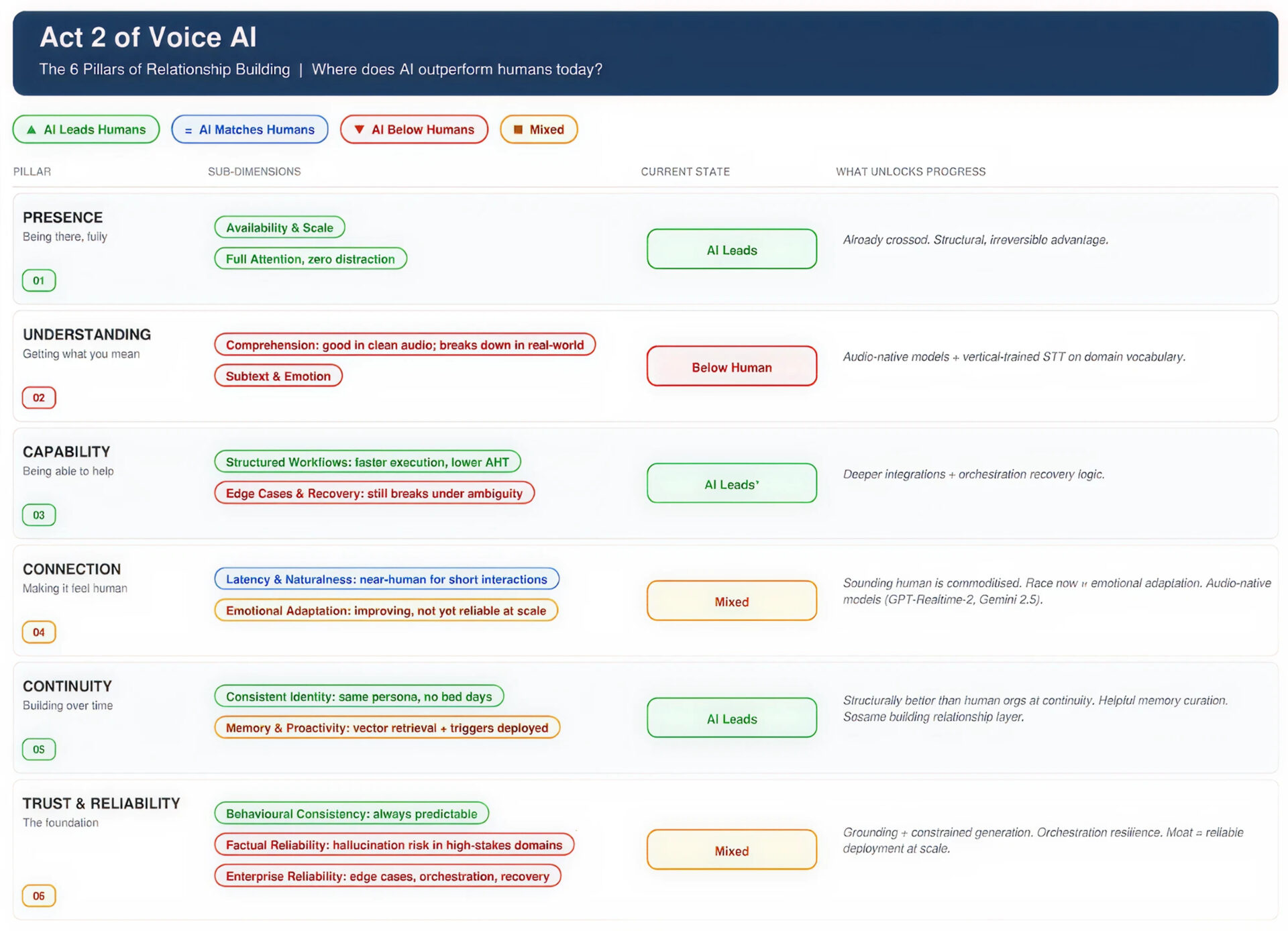
1. Presence — AI Already Leads
Think of the last time something went wrong unexpectedly — a flight canceled, a payment declined, a family health scare. If someone picked up, that single moment built more trust than ten routine interactions.
Humans have limits: business hours, hold queues, shift changes, tired agents. Voice AI has none of these. Good deployments answer instantly, operate 24/7, and handle thousands of simultaneous calls without fatigue. The AI that picks up at 2 a.m. while you are stressed — patient, calm, fully attentive — creates a relationship moment that most traditional support organizations rarely even attempt. This is a structural advantage that widens over time.
2. Understanding — The Biggest Blocker
A customer calls and says, “I’ve been dealing with this for three weeks.” Those seven words contain frustration, a history of failed attempts, and sometimes an implicit threat to leave. They are not a support ticket. They are a signal.
Understanding has two layers. What you say: In clean audio with standard vocabulary, the best systems are genuinely good. In real contact centers — thick accents, code-switching, city names that appear in no training corpus — error rates rise substantially. What you mean: hearing “I’m just checking on my order” and understanding it as “I’m anxious this gift won’t arrive before the wedding” is a different cognitive act. AI does this inconsistently, improving with audio-native models that preserve tone and hesitation rather than discarding them in transcription, but it’s not yet reliable across the full range of human emotional expression.
Understanding is the single biggest blocker to Act 2. It is where the experience most often breaks.
3. Capability — AI Already Leads on Structured Workflows
A human agent logs into a CRM, pulls up the account, navigates the refund workflow, and updates the record. That takes minutes and introduces errors at each step. An AI agent with proper integrations executes in parallel — no switching, no hold time, confirmation sent before the call ends.
Where it breaks: edge cases. When a customer says, “actually wait, I want to change that” — the system is two API calls deep, and recovery logic gets complicated fast. Many systems freeze or hand off without explanation. The winning systems will not have the best models. They will have the deepest integrations and the best recovery logic when things go wrong.
4. Connection — The Gap Is Narrowing
The shift to continuous audio-native pipelines — now in production with GPT-Realtime-2 and Gemini 2.5 Flash Native Audio — removes latency by treating transcription and synthesis as a single step. The model hears you rather than reads you. The best systems respond under 300 milliseconds. At these speeds, the mechanical pause that gives AI away starts to disappear.
But sounding human is increasingly commoditized at the frontier. The next race is knowing when to be warm, when to be concise, and when to slow down. That is a harder problem than naturalness — and a more defensible one.
5. Continuity — AI’s Most Underestimated Advantage
We assume humans are good at continuity. In practice, human service organizations are structurally bad at it. Different agents take your call each time. Context disappears at transfer. Staff turns over. Whatever the last person knew about your preferences went with them.
AI has none of these problems within its design constraints. The same identity shows up every time. Context from the last call is retrieved before this one begins. No bad days. No shift variation. The leading platforms already use vector retrieval to surface relevant history and trigger engines for proactive outreach — renewal nudges, post-resolution check-ins — in production.
The nuance: the goal is not total memory, it is helpful memory. A system that retrieves everything creates noise; one that retrieves the right things creates trust.
6. Trust & Reliability — The Hidden Foundation
Every other pillar sits on top of this one. Remove it, and the whole structure collapses.
Behavioral consistency: AI already wins. Same standards, same patience, same persona — no cutting corners on a Friday afternoon.
Factual reliability: still deeply unsolved. Models occasionally say incorrect things with genuine confidence. In healthcare, insurance, and financial guidance, that is not acceptable. The best systems say, “I’m not fully sure — let me verify that,” rather than confabulating a confident answer. The winning approach is deep integration with source-of-truth systems — CRM, EHR, policy documents — constrained generation grounded in verifiable facts.
Enterprise-grade reliability: the dimension the industry under-discusses. Enterprises don’t refuse to deploy because the AI sounds slightly robotic. They refuse because it fails unpredictably. API timeouts mid-transaction. Ambiguous requests that send the orchestration layer into a loop. Duplicate bookings from retries. At scale, these compound.
The breakthrough moment is quiet. It happens when users stop noticing reliability at all — when “wow, this AI actually handled it” becomes simply “of course it did.”
WHAT MOVES THE NEEDLE
Two pillars — understanding and enterprise-grade reliability — most directly throttle the transition. Five things are worth watching:
- Audio-native models hitting production quality. The architecture shift and the understanding bottleneck are the same problem. Models that hear rather than read preserve acoustic cues that transcription permanently discards.
- Vertical models cracking real-world speech. A model trained on millions of real BFSI conversations understands that “ECS bounce” means something different from “technical error.” The gap between generic and vertical is wider in understanding than anywhere else.
- Reliability is becoming the moat. Sounding human is increasingly commoditized. Enterprise deals will be won by whoever makes deployment boring-reliable — orchestration that does not break when reality deviates from the happy path.
- Sesame — the company betting on relationship as the product. Founded by Brendan Iribe and backed by Sequoia, their thesis is that an AI companion should be someone you want to return to, not just someone who handles your request. Their research named the precise frontier: without conversation history, their model is indistinguishable from human speech. With context, human speech still wins. They published that because it names exactly what they are building toward.
- Grounding at scale. Whoever solves this wins enterprise. Not model quality — trusted, reliable deployment at scale.
Act 1 is still running. Still generating value. It was the right first chapter.
Act 2 is where it gets 10x better. The interface layer of the next decade might be a voice — because it is more reliable, more consistent, more present, and increasingly better at understanding than the human on the other end of the line.
My hotel story was a failure of relationship. Three agents. No memory. No follow-through.
The company that fixes that — reliably, at scale, across every interaction — does not just reduce support costs. It earns the customer. And the company that earns relationships at scale may quietly own a category that does not yet have a name.
A longer version of this article was originally published on Medium >