
AI has changed from a software business to an infrastructure business. That changes how the industry is financed and where the risk accumulates.
For thirty years, big tech proved it did not need debt. Microsoft issued its first corporate bond in 2009. Google in 2011. Meta in 2022. These were companies defined by generating more cash than they knew what to do with. The equity story was the whole identity of the tech sector. VC, since the first formalized funds in the 60s and 70s, has also been defined by success stories in equity holdings in tech companies.
That identity is now breaking. In 2025, the largest hyperscalers issued $100+ billion in bonds, much higher than their recent annual average. AI-related borrowing has become one of the largest segments of the US investment-grade market. A sector that spent a generation avoiding debt is now one of its heaviest users.
Software has beautiful economics. Build the product once, sell it a million times, and each additional customer costs almost nothing. AI (and frontier models specifically) inverts this. Each additional customer consumes compute, requiring more hardware and capital. So they borrowed. And once a depreciating physical asset (the chips) is funded with debt, one has left the world of software economics and entered the world of project finance, where the only question that matters is whether the cash flow arrives in time to service the loan. There are two buckets to consider:
Bucket One: Hyperscalers
When Microsoft, Google, Amazon, or Meta issues a bond, it is a general obligation of the entire company, serviced from total cash flow. It does not matter whether a specific data center earns a dollar; revenue from the advertising and/or cloud businesses can cover the coupon. Each of these companies generates tens of billions in revenue every quarter. That being said, a lot of the debt is opaque private credit and hard to track. The reported debt seems manageable, but all the stuff off-balance sheet is hard to predict. If AI underdelivers, the hyperscalers would need to write down enormous investments.
Even hyperscalers are beginning to reflect the financial consequences of unprecedented AI investment, with recent earnings highlighting the growing impact of capital expenditure and investment-related income.
Bucket Two: AI Infrastructure Companies
The second bucket is datacenter operators and neoclouds. Neoclouds are cloud-service providers who are AI-oriented: CoreWeave, Lambda, Crusoe, Nebius, Applied Digital, Fluidstack and their peers, who buy GPUs with borrowed money and rent out the compute to loss-generating AI Labs that are spending investor money.
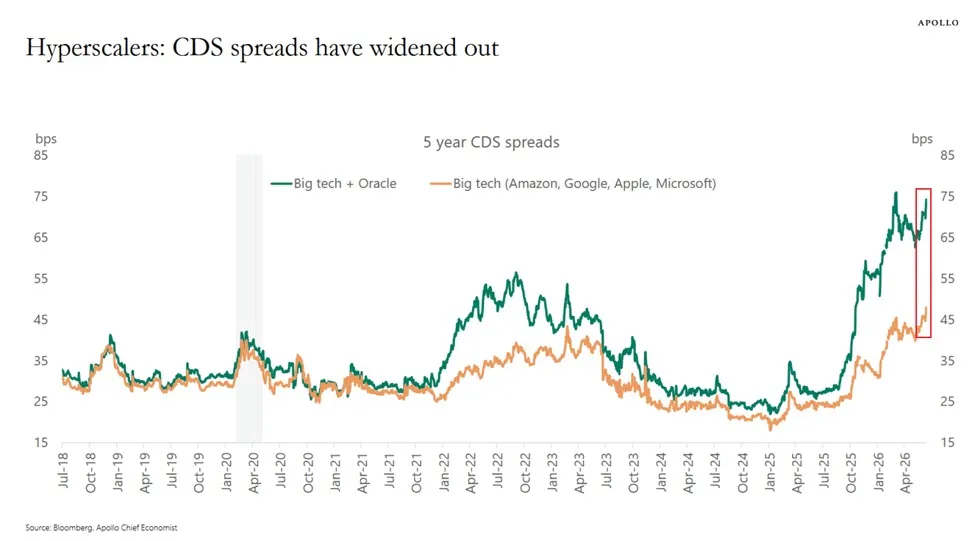
It is worth mentioning Oracle, who, these days, is somewhere in between hyperscaler and datacenter operator, making it an interesting case study because of its reliance on OpenAI demand. Credit default swap spreads, a market measure of perceived credit risk, have widened for Oracle and the hyperscalers.
This financing structure creates four sources of risk:
1/ Duration mismatch
The debt is often structured over five to six years. The core asset, the GPU, is economically useful for perhaps three years (optimistically), before it is exhausted or a new generation makes it obsolete and its resale value falls away. They are financing a short-lived asset with longer-lived debt, and much of that debt comes due inside the same narrow window. The asset can be worthless while the loan is still outstanding.
2/ Debt serviceability of borrowers
Much of this debt is rated investment-grade despite being issued by borrowers who, on their own, are decidedly not: the neoclouds. Trace the demand far enough and a meaningful share of it terminates in the frontier labs – OpenAI, Anthropic, xAI and the rest – which still spend far more than they earn and depend on the next round to continue.
3/ Lender concentration
The debt sits in bankruptcy-remote vehicles, ring-fenced so that one failure does not legally cascade into the next. But the same small group of private credit firms – Blackstone, Apollo, BlackRock, Blue Owl – lend to the hyperscalers’ structures and to the fragile neoclouds. All of the above are financial intermediaries investing money on behalf of other institutions. Institutions like pension funds and insurance companies, which get their money from ordinary citizens.
4/ Circular financing
Parts of the ecosystem increasingly finance demand for one another. Here is an illustrative example:
- NVIDIA is an investor in OpenAI.
- NVIDIA is also an investor in CoreWeave.
- CoreWeave uses the NVIDIA money to buy NVIDIA chips and leases them out to OpenAI.
- OpenAI uses some of the money it got from NVIDIA to pay CoreWeave rent money. NVIDIA outperforms earnings expectations.
- But NVIDIA reports “other income” – increased valuations of companies it has invested in.
- Increased valuations because they are using NVIDIA money to buy NVIDIA products.
Jacques Reuff was a French economist (and advisor to Charles De Gaulle) who did not like the Bretton Woods system. He critiqued: “If I had an arrangement with my tailor, whereby for every suit I buy from him, he immediately gives me back my money in the form of a loan, I would have no objection to buying more suits from him.”
This is not international monetary economics, but it is a similar(ish) situation. The hyperscalers, AI labs, datacenter operators and neoclouds have received billions of dollars in equity inflows and have taken billions of dollars in loans from a bunch of private credit funds; many suits, many tailors and many loans are involved.
Tinder can sit on a forest floor for years without a fire. Whether these risks materialize remains uncertain. But one thing is already clear: AI has changed the economics of technology. Increasingly, the cost structure of AI startups is being shaped by the capital structure of the infrastructure providers they depend on, and their two largest loss-making clients.
For founders, this is a fundamental shift. If products sit on top of a frontier model API, unit economics are downstream of someone else’s balance sheet, and that balance sheet is more leveraged than it looks. A slowdown in frontier-lab fundraising doesn’t just threaten OpenAI or Anthropic’s next round; it tightens the credit that keeps the neoclouds solvent, which is the same credit keeping inference cheap enough for businesses to work.
Founders building AI-native products should be asking two questions now: how much of my cost structure depends on compute prices staying where they are, and what’s my plan if a lab-side funding gap forces a repricing of that compute. Building on frontier models remains a compelling opportunity. But founders should model the downside before someone else’s leverage becomes their emergency.
Dhruvan Juneja is Associate, Investor Relations. A version of this piece was originally published here>>