
The Playbook behind legendary Investors

How does one person — investing alone, with no analyst team — repeatedly back Stripe, Airbnb, Coinbase, and Figma before most institutional firms did? Elad Gil’s track record is comparable to the best venture funds of the last decade, built with no partners, no investment committee, no sourcing team. Meanwhile, top-tier VC firms with armies of analysts are increasingly struggling to return their funds.
That gap pushed me to look for primary sources: investment memos, books, recorded talks, documented deal histories. The goal was to understand not what great investors say they look for, but how they actually think.
The twelve investors below were selected on three criteria: each has multiple investments with documented returns above 50x (verifiable from public filings or acquisition announcements); each left a documented record of their decision-making; and together they span six decades of investing (1972 to present), every major stage, and fund sizes from individual angels to $100B. Any pattern that holds across that range is structural — not a product of era, firm, or personal style.
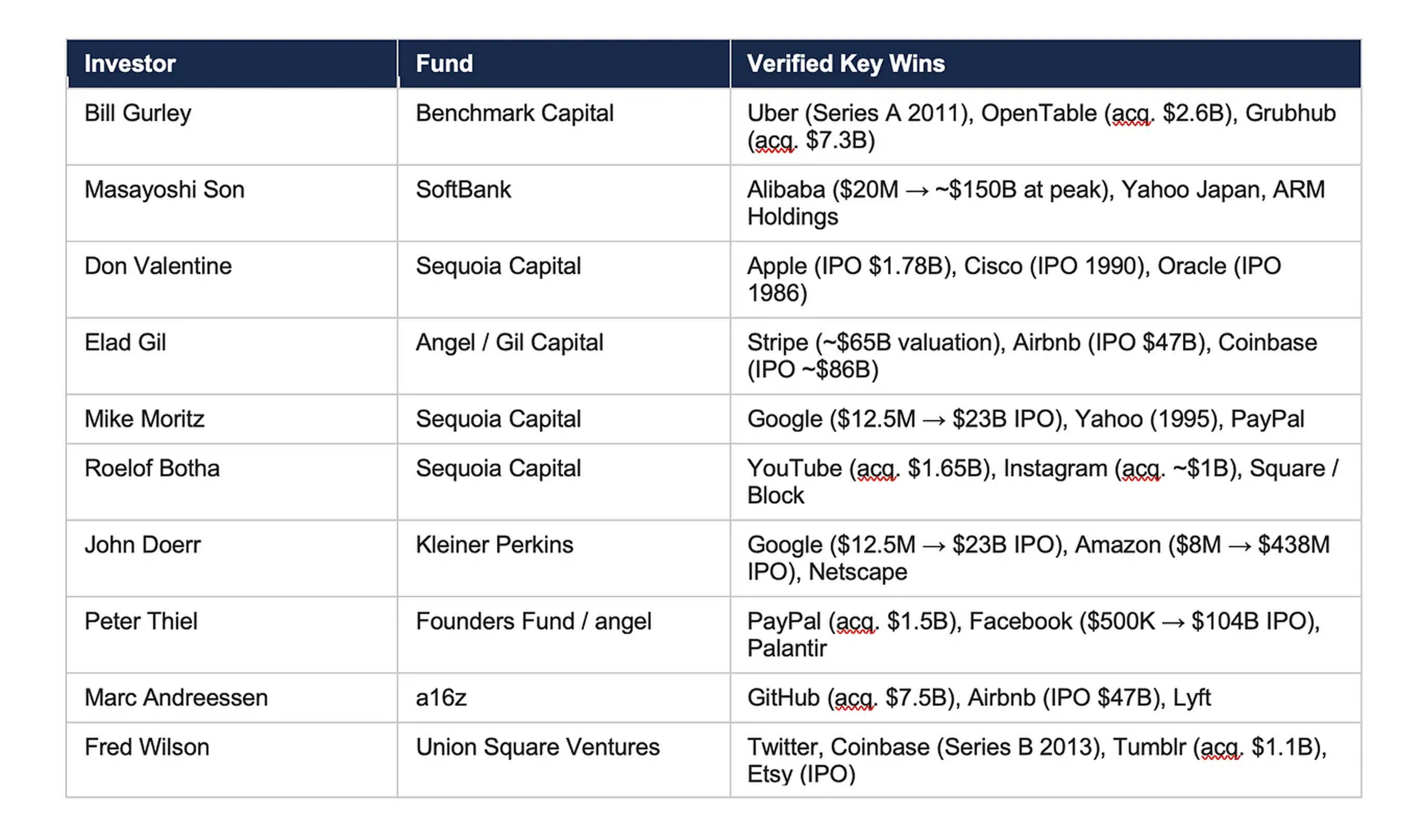
All outcomes above are sourced from public filings, acquisition announcements, or documented investment records.
The Conventional Wisdom Gets It Wrong
The standard framing is that great investors fall into two camps — market-first or founder-first. Don Valentine: “We don’t choose people. We choose markets. Give me a giant market always.” Masayoshi Son invested in Alibaba after a brief meeting with Jack Ma because of his “shining eyes” and leadership presence. These accounts suggest two completely different philosophies.
But when you look at the actual deals not the quotes, the pattern is identical across all 12.
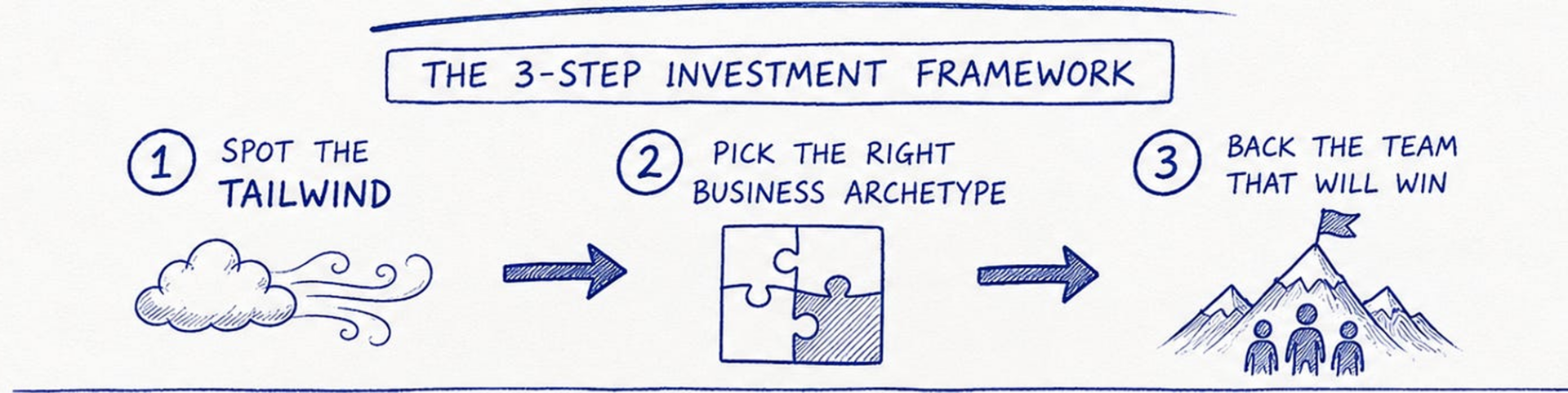
1. They spot a massive technology tailwind that signals the right moment for a new category.
2. They identify which business model or theme is up for grabs within that tailwind.
3. They find the team best positioned to build the category-defining company.
The style difference is in the order of operations. The underlying investment logic is the same.
Even Son’s Alibaba investment — his most “founder-first” story — was preceded by a specific market thesis: China’s internet penetration in 2000 matched the US in 1995. He knew the category before he met the founder. The “shining eyes” determined which founder got the cheque, not whether he would write one.
A note before the analysis: this is necessarily retrospective. Great investors also make many failed bets, and success makes decision-making appear cleaner than it was in real time. The goal here is not to argue these frameworks guarantee outcomes, but that certain patterns appear repeatedly among investors who compounded exceptional returns over long periods.
How They Spot Tailwinds
Seven signals appear consistently across these investors’ best decisions. Each is grounded in specific, concrete data inputs.

1. Spend Time With Technical Talent
The most reliable leading indicator of the next major category is what the most capable engineers are doing voluntarily, with no commercial incentive. They reveal the next platform through what they build in their spare time, what they complain about in technical communities, and what they adopt simply because it’s better — even when rough and unfinished. The investors who exploit this do it deliberately, making recurring visits to university labs, developer communities, and technical conferences. The question they’re asking: what will be possible in three to five years that is not possible today?
John Doerr / Kleiner Perkins → KPCB internet portfolio: Sun Microsystems, Netscape, Amazon, Google
Doerr made regular visits to university computer science departments and DARPA-funded research labs throughout the 1980s and 1990s, asking a single question: what will be possible in three to five years? From those conversations, he saw networked computing being built by researchers years before any commercial product existed. The Kleiner Perkins internet thesis came from watching the most technically capable people at Stanford — not from market research. Sun, Netscape, Amazon, and Google all followed that same thesis.
Source: John Doerr, Measure What Matters (2018); Kleiner Perkins portfolio history
Elad Gil → Stripe (~$65B valuation, 2023)
Before investing in Stripe, Gil was embedded in the developer community as a practitioner who had run technical teams at Google and Twitter. He observed engineers voluntarily adopting Stripe’s API — seven lines of code versus weeks of compliance overhead — with no sales contact from Stripe. His investment came from independent observations across unconnected engineering teams, not from a pitch.
Source: Elad Gil, Invest Like the Best podcast; Lex Fridman podcast
2. Track Infrastructure Cost Curves
Every time the cost of a core technology drops by an order of magnitude, a new class of products becomes viable that wasn’t before. Valentine’s method: track the cost curve of enabling technologies — semiconductors, networking silicon, storage — and calculate the price at which a specific product becomes viable at volume. He didn’t wait for the product to exist. The opportunity opens when cost is 12–24 months from viability and closes when the category becomes obvious.
Don Valentine / Sequoia → Apple (IPO $1.78B, December 1980)
Sequoia’s 1977 investment memo classified the deal as “M. Priority” and described the market as “Home — Hobby Computers” at >$500M. Valentine’s framework: microprocessor cost had dropped to the level where a sub-$1,500 consumer computer was viable for the first time. Sequoia invested in a $600K round for ~10%. Apple IPO’d at $1.78B market cap on December 12, 1980.
Source: Sequoia 1977 Apple investment memo, published April 2026; Apple IPO, December 12, 1980
Don Valentine / Sequoia → Cisco (Sequoia invested $2.5M for ~30%, 1987)
Networking silicon had fallen below the cost point where router hardware could be sold profitably to enterprises outside the Fortune 500 for the first time. Cisco’s founders had been rejected by numerous other investors. Valentine saw the cost curve; others didn’t.
Source: Don Valentine oral history, Computer History Museum
3. Track Capability Thresholds
Technology doesn’t just get cheaper — it crosses capability thresholds that make previously poor experiences genuinely good. Botha’s approach: track hardware capability curves (camera quality, GPS accuracy, battery life, processor speed) against application categories where experience was still inadequate. The question at each step: is there an app that would be genuinely good at this capability level, but was genuinely poor at the level before? When yes, the category has just become investable.
Roelof Botha / Sequoia → Instagram (Facebook acquired for ~$1B, April 2012) The iPhone 4, released June 2010, shipped with a 5-megapixel camera — the threshold at which mobile capture quality crossed from tolerable to genuinely good. Instagram launched in October 2010, 3.5 months later. Photo sharing behaviour was already established on desktop. What changed was the hardware making mobile capture genuinely good for the first time.
Source: Sequoia Capital Crucible Moments podcast, Roelof Botha episode
4. Track Technology Penetration Across Geographies
Technology adoption follows a predictable S-curve in every market. Once you have that curve for the leading market, you can identify lagging markets running 18–36 months behind. Son’s method: if China’s internet penetration in 2000 matched the US in 1994–95, the business models proven in the US between 1995 and 2000 are likely to prove out in China over the next five years — at prices that reflect local investor uncertainty rather than confirmed outcomes. The edge is acting on that arithmetic before local consensus forms.
Masayoshi Son / SoftBank → Alibaba ($20M for ~34%, 2000; ~$150B peak value)
Son tracked internet penetration rates across geographies and calculated that China’s adoption curve was running several years behind the US. He met Jack Ma briefly. What confirmed his decision was Ma’s vision and conviction — but the category thesis existed before the meeting. SoftBank’s $20M generated returns reported at approximately $150B at peak value.
Source: QZ; Fortune; South China Morning Post; Son in multiple public interviews
5. Identify Irreversible Behaviour Shifts Already Underway
The signal isn’t whether a company has created a new behaviour. It’s earlier: is there a behavioural shift already happening — driven by new technology — that a company can systematise and own?
People do not wait for a great product before they start changing how they behave. They improvise. They do the new thing badly with inadequate tools: sharing video files by email, coordinating rides via SMS, paying each other through clunky bank transfers. The behaviour exists before the right product does.
The question to ask: is there something people are clearly trying to do, at meaningful scale, with tools that were not designed for it? If yes, the demand is real. What doesn’t yet exist is the infrastructure to make it reliable. That gap is the investment.
Roelof Botha / Sequoia → YouTube (Sequoia invested ~$11.5M; Google acquired for $1.65B, October 2006)
People were already sharing video before YouTube launched — through email attachments, crude hosting sites, and peer-to-peer networks. The behaviour was real but fragmented. YouTube didn’t create video sharing; it made an existing, proven demand dramatically better. Botha’s September 2005 investment memo recognised that broadband had crossed the threshold making video streaming viable — and that enormous, proven behaviour was waiting for the right infrastructure to own it.
Source: Sequoia YouTube investment memo, September 2005 (public via litigation); Google acquisition press release, October 2006
6. Track Underutilised Supply in Fragmented Markets
In fragmented industries, significant supply capacity sits idle not because demand is absent but because the matching layer is broken. Gurley’s marketplace checklist: identify a large, fragmented industry; measure supply utilisation; calculate why utilisation is low — matching problem, trust problem, or discovery problem? Assess whether a platform solves it in a way that compounds with scale. High fragmentation + high idle supply + a matching barrier = a marketplace worth building.
Bill Gurley / Benchmark → Uber ($11M Series A, February 2011)
Gurley published his marketplace framework openly on his blog “Above the Crowd.” Travis Kalanick read it and reached out directly. The blog didn’t generate warm introductions — it generated founders who had already self-selected against the framework.
Source: Kalanick in multiple interviews; Bill Gurley, “Above the Crowd”; Benchmark Series A reported February 2011
Bill Gurley / Benchmark → OpenTable (Series B 2000; Priceline acquired for $2.6B, June 2014)
Same framework: restaurant table inventory sitting empty because phone-based reservation created friction on both sides of the market.
Source: Gurley on OpenTable in multiple interviews; Priceline-OpenTable acquisition: WSJ and TechCrunch, June 2014
7. Track How Long a Category Has Gone Without Structural Innovation
In markets where the dominant product design hasn’t changed in a decade or more, a specific dynamic builds: customers often continue paying because alternatives are equally inadequate, not because the product is good. Complexity accumulates. Pricing opacity grows.
Customer frustration alone is not enough. The real question is: how long has the dominant design been unchanged, and has a new technological shift now made a dramatically better architecture possible? Long stagnation plus an enabling technology equals an open category.
Peter Thiel → PayPal (co-founded 1998; eBay acquired for $1.5B, October 2002)
Online payment in 1998 required merchant accounts, payment gateways, and lengthy application processes — complexity that served financial incumbents rather than merchants or consumers. The dominant infrastructure hadn’t structurally changed since the early 1990s. PayPal replaced the process with an email address and a password.
Source: eBay acquisition press release, October 2002; Thiel, Zero to One (2014)
Doug Leone / Sequoia → ServiceNow (Sequoia led $41M round, 2009; IPO June 2012 at ~$2.96B)
Enterprise IT service management was dominated by BMC Remedy, first released in 1991. By 2009, the dominant architecture was ~18 years old — built for on-premise infrastructure that cloud computing was making obsolete. ServiceNow was rebuilt from scratch for a cloud-native world. Net revenue retention above 120%. Leone argued against a $2.5B VMware acquisition offer, calling it “giving away the company.”
Source: Sequoia Capital, “The ServiceNow Story”; ServiceNow IPO prospectus June 2012
What Kind of Company Rides the Tailwind?
The same tailwind can produce structurally different types of companies. Being clear on which type shapes what you look for in the team. Five patterns appear consistently:
A — Bottleneck Created by New Infrastructure. The new platform creates a constraint that didn’t exist before. Oracle solved the data management problem created by the PC wave. Stripe and Twilio solved the payments and communications bottlenecks created by AWS.
B — Bottleneck About to Become Evident. The infrastructure is in place; the constraint hasn’t hit critical mass yet. Investing before the pain is acute gives you entry price before the category is contested. ServiceNow in 2009: cloud adoption was making on-premise IT management inadequate before most enterprises felt it acutely.
C — Act 2 of a Proven Model on New Infrastructure. A behaviour was validated on one platform; new infrastructure makes the same behaviour dramatically better on the next. YouTube was Act 2 of photo sharing (proven via Flickr on desktop) once broadband removed the buffering barrier.
D — A New Delight Made Possible by New Technology. Something genuinely new — not a migration from a prior platform, but a behaviour only possible because of the specific capabilities the new platform provides. Instagram wasn’t Flickr on a phone. The combination of persistent connectivity, always-present camera, and social graph created a sharing loop desktop couldn’t replicate.
E — A Differentiated Attempt at an Existing Space. The category exists; a new entrant has a structural insight competitors cannot replicate without rebuilding from scratch. Google’s PageRank required re-crawling and re-indexing the entire web. Altavista couldn’t flip a switch. Facebook’s real-identity architecture meant Myspace would have had to ask 100M pseudonymous users to verify themselves.
How They Source
Three mechanisms appear consistently across all 12 investors: network, media, and going deep into a domain before the category becomes obvious to others. Each is deliberate, not passive.

1. Network — The Pre-VC Career Gives You the First Edge
Most of these 12 investors didn’t enter venture capital as career investors. Their pre-VC careers — as engineers, operators, or founders — gave them networks no generalist investor could replicate.
- Don Valentine spent seven years at Fairchild Semiconductor, the nursery of Silicon Valley. Its alumni founded Intel, AMD, and National Semiconductor. Apple and Cisco entered his pipeline through those relationships, not through formal pitch processes.
- Peter Thiel had personal relationships with the entire PayPal founding team — who went on to found or fund LinkedIn, YouTube, Yelp, Palantir, and SpaceX. His $500K Facebook investment came through Sean Parker, who he knew through that network.
- Elad Gil spent years as a product leader inside Google and Twitter. When Stripe began getting adoption among developers, he heard about it from engineers he knew at other companies — not from a pitch.
- Marc Andreessen had operated at the technical frontier across two complete waves before ever writing a cheque. Founders sought his board involvement because he had done the operational work himself — a different category of trust from reputation alone.
The investors who sustained their edge built networks intentionally — not to accumulate contacts, but to maintain ongoing access to the best technical talent and deal flow in their target sectors. Masayoshi Son built government relationships in Japan that gave SoftBank a regulatory and distribution advantage in mobile and internet infrastructure. His $100B Vision Fund secured a critical $45B commitment from Saudi Arabia’s Public Investment Fund — a relationship that predated the fund.
2. Media — Publishing Creates Inbound
The mechanism has shifted across three eras. In the 1980s–90s, it was trade press: investors quoted regularly in publications that founders read became the first call. In the 2000s–10s, it became the blog — from being cited in someone else’s piece to owning a point of view directly. In the 2020s, it’s the media house.
Bill Gurley / Benchmark → Uber — Travis Kalanick found Gurley through the blog
Gurley published detailed frameworks on marketplace dynamics with enough specificity that founders could run their own business through the framework. Kalanick read it and reached out directly. The blog didn’t generate warm introductions — it generated founders who had already self-selected against the framework.
Source: Kalanick in multiple interviews; Bill Gurley, “Above the Crowd”
a16z describes itself as a media company that monetises through venture capital — it runs one of the largest technology podcast networks, publishes Future.com, and employs a full editorial team. 20VC closed a $400M third fund in October 2024, raised in approximately four months. The pattern — build a media presence with a specific point of view, convert the audience into a deal pipeline — is now a recognised playbook in venture capital.
3. Going Deep Into the Domain
Domain immersion means spending more time in a specific category than any other investor, before the category is obvious. The result is a “prepared mind” — a pre-built framework against which every incoming company is evaluated instantly. The decision is fast not because the investor moves quickly, but because the intellectual work was done before the company arrived.
When you’re known to think more carefully about a specific category than anyone else, founders route deals to you without being asked — not for your capital, but because a conversation with you produces insight they can use. The compounding is real. It explains why the best investors in a given wave — Gurley in marketplaces, Wilson in open-protocol networks, Andreessen in developer tools — see a disproportionate share of the best companies.
Jim Breyer / Accel → Facebook ($12.7M Series A, 2005; returned entire Fund IX)
Accel had been tracking social networking before Facebook pitched and had formed a specific view of what the category leader would look like: a network built on real identity, with verified users, starting from a dense community before expanding. When Facebook pitched, Breyer moved quickly against internal scepticism because the intellectual work was already done.
Source: TechCrunch, “Accel Partners’ Extraordinary 2005 Fund IX,” November 2010
How They Pick the Category Leader
Six signals for category leadership appear consistently. These are concrete data points, not impressionistic assessments of founder quality.

1. Trusted Referral
A trusted referral means three things together: someone with direct, hands-on knowledge of the product; who knows you well enough to judge what you look for; and who has your best interest at heart. All three together is what makes it signal rather than noise. David Cheriton had personally invested in Google alongside Andy Bechtolsheim and introduced both Moritz and Doerr — not because he was promoting it, but because he thought they’d regret missing it.
2. Network-Verified Signals on Competitive Position
Category leadership is confirmed not just through the company’s own metrics but through third-party signals: traffic growth data, app store rankings, API usage patterns. Botha’s YouTube investment memo shows competitive position assessed using traffic growth data before the term sheet was signed.
3. Proven Leadership in a Constrained Geography
The category leader dominates one geography before any competitor does. Geographic concentration makes competitive dynamics, unit economics, and retention visible at real scale — without the noise of premature national expansion.
- Uber: San Francisco dominance in 2010–11 proved end-to-end model economics before national expansion.
- Airbnb: New York City host density and guest repeat rates in 2010 validated the two-sided marketplace.
- OpenTable: San Francisco restaurant density was the proving ground before national rollout.
4. A Structural Differentiation That Cannot Be Quickly Replicated
The category leader has a product advantage competitors cannot close by increasing budget or headcount.
- Facebook: Real identity at the architecture level. Myspace couldn’t replicate this without asking 100M pseudonymous users to verify themselves.
- Google: PageRank required re-crawling and re-indexing the entire web with a different algorithm. Altavista couldn’t flip a switch.
- Stripe: Developer-first API design meant adoption was bottom-up through engineering teams. Incumbents’ sales-led motion couldn’t replicate this without a structural rebuild.
5. Organic Growth With Zero Paid Acquisition
Zero paid acquisition at meaningful scale is more than a cost metric — it means the product is spreading through genuine value delivery.
Marc Andreessen / a16z → GitHub ($100M Series A, July 2012; Microsoft acquired for $7.5B, October 2018)
GitHub grew from launch in 2008 to 1 million users entirely through word of mouth — no sales team, no marketing budget. Engineers added GitHub profiles to resumes. Recruiters asked for GitHub handles.
Source: TechCrunch, July 2012; Microsoft press release, June 2018
6. Network Effects as a Structural Moat
The category leader has a product that gets more valuable with each additional user. Unlike a technology advantage (which a well-funded competitor can eventually match), network effects improve over time rather than decay. Two-sided marketplaces, communication platforms, and protocol-layer products all exhibit this.
Fred Wilson / USV → Coinbase (Series B, 2013)
Wilson’s thesis: open protocols (Bitcoin, Ethereum) would eventually require a trusted consumer on-ramp. The company that built the most trusted interface to the protocol would capture significant value from the protocol’s network effects. USV invested in Coinbase’s Series B in 2013 — four years before the 2017 crypto boom.
Source: USV thesis, usv.com; Coinbase direct listing April 2021
The Replicable Playbooks
The investors who built the most durable track records operationalised their frameworks into repeatable playbooks — the same logic applied across categories and cycles. Four stand out for specificity and longevity.
Playbook 1 — Bill Gurley: Marketplace Supply Utilisation
What share of supply is idle? What’s the structural reason for the mismatch? Does the platform solve the matching problem in a way that compounds with scale?
- Uber: Idle vehicle capacity in major cities; real-time mobile matching as the fix. Led $11M Series A, February 2011.
- OpenTable: Restaurant table inventory wasted by phone-based reservation friction. Series B 2000; acquired by Priceline for $2.6B, 2014.
- Grubhub: Restaurant kitchen capacity idle during off-peak hours. Just Eat Takeaway acquisition for $7.3B, 2021.
The framework was published openly. The founders who called Gurley were the founders whose businesses already passed the first test.
Playbook 2 — Masayoshi Son: Penetration Curve Time Machine
Track technology penetration rates across geographies. Identify markets running 18–36 months behind the leading market. Invest in the proven model at the point where the outcome is statistically likely but not yet priced in by local investors.
- Yahoo Japan: Japan’s internet penetration in the mid-1990s tracked several years behind the US. SoftBank co-founded Yahoo Japan in 1996.
- Alibaba: China’s e-commerce penetration in 2000 tracking behind the US. SoftBank’s $20M for 34% generated approximately $150B at peak value.
Playbook 3 — Don Valentine: Cost Curve Economics
Map the cost decline curve of enabling infrastructure. Identify products that become viable when cost crosses specific thresholds. Invest while the cost is still falling — the window closes when cost stabilises and the category becomes obvious.
- Apple (1977): Microprocessor cost had dropped to the level making a sub-$1,500 consumer computer viable for the first time. Sequoia invested in a $600K round for ~10%; Apple IPO’d at $1.78B market cap.
- Cisco (1987): Networking silicon had fallen below the cost point where enterprise routers could be sold profitably outside the Fortune 500. Sequoia invested $2.5M for ~30%.
Playbook 4 — Elad Gil: Infrastructure Layer Cluster Investing
When a new infrastructure layer achieves developer adoption — AWS compute, iOS, Ethereum — a cluster of enabling companies must be built before the application layer can scale. Invest in the enabling companies first. Infrastructure appreciation leads application appreciation by 2–3 years.
- Stripe: Payments infrastructure for the web commerce layer being built on AWS.
- Airbnb: Trust and payment infrastructure for peer-to-peer marketplace transactions.
- Coinbase: Consumer on-ramp to the crypto protocol layer before consumer applications existed at scale.
The Through Line
The investors on this list who built 20-year track records share one property: they turned their judgement into a system. Tailwind identification is systematic. Sourcing follows the thesis. Category leader identification follows concrete, repeatable signals.