
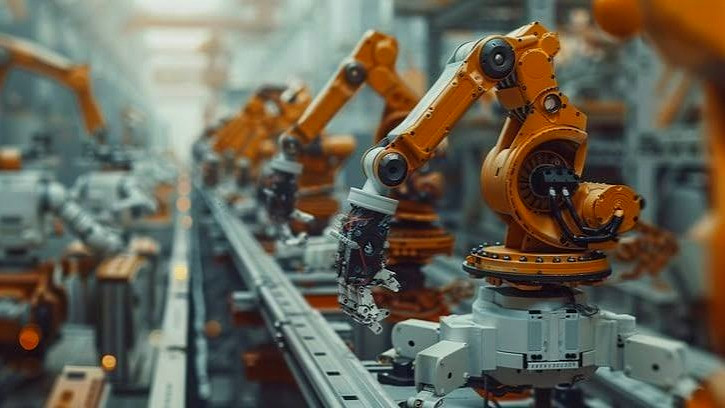
India’s robotics ecosystem is advancing rapidly, but its biggest bottleneck remains the precision manufacturing layer beneath the AI.
In 2000, a Bengaluru company built a robotic arm where every joint was independently intelligent and networked. It was a feature that would not become a standard in collaborative robots globally for another decade. Yet, the arm never found its market. This did not happen because someone built something better. It happened because every single component that made it actually work had to come from Japanese and European suppliers, and once you added those costs up, the economics simply did not hold.
That story tends to get told as one company’s isolated misfortune. In reality, it is much more useful as a structural pattern, one that has repeated itself quietly across every wave of Indian robotics since.
When large Indian manufacturers did eventually begin automating at scale, they bypassed domestic options and reached for proven foreign hardware every single time. By the mid-2010s, Maruti Suzuki’s plants in Manesar and Gurgaon were running roughly 5,000 imported robots across their lines, sourcing from Fanuc, ABB, Kawasaki, Yaskawa, and KUKA. Around 2011, Bajaj Auto became one of the first in the country to adopt collaborative robots, choosing Universal Robots from Denmark. Royal Enfield’s plant near Chennai bought from ABB, while Mahindra’s Nashik factory built its welding lines around imported systems. The domestic robotics companies that existed through this period were largely locked out of the boom happening right next to them, simply because buyers prioritized global reliability over domestic experimentation.
The underlying constraint that stopped that first wave has not gone away. The precision components that actually determine what a robot can do — servo motors, harmonic drive reducers, encoders, and motion controllers — are still almost entirely imported in India today, primarily from Japanese and European suppliers, with China increasingly undercutting both on the lower end. These are not peripheral parts; they are what makes a joint move precisely, what gives an arm its dexterity, and what lets a mobile robot navigate reliably. To put the scale of this problem in perspective, India’s entire national robot installation in 2024 was roughly 9,100 units. China installed 295,000 in the same year.
Assembled in India is not the same thing as built in India. That distinction is where the first wave got stuck, and it is the same distinction that matters most in this one. So, the question worth asking about any Indian physical AI company right now is not whether the product is good or whether the team is brilliant. It’s how far down “in India” actually goes, and whether that answer holds together when you’re building your hundredth unit instead of your first prototype.
Fortunately, that question is finally starting to attract interesting answers from an unexpected direction. Sona BLW Precision Forgings, a company that built its reputation making precision gears for the automotive industry, approved a significant capital commitment in June 2026 to manufacture components for the robotics industry. They have also confirmed a strategic partnership with Germany’s Neura Robotics to jointly develop robots, humanoids, components, and sub-assemblies for India and other markets. The logic is direct: the high-torque, precision-engineered parts that go into an EV powertrain are the very same parts a robot joint needs.
Similarly, Bharat Forge signed an MoU with Munich-based Agile Robots in January 2026 to co-develop AI-driven robotics and intelligent industrial automation solutions, combining Bharat Forge’s manufacturing scale with Agile’s robotics and software capabilities. Even startups are shifting vertically; Ethereal Machines, which traced its origins to a Bengaluru college dorm in 2010, spent years failing to build a robotic arm because precision CNC machining was not available locally at a reasonable cost. Instead of giving up, they built the CNC machines themselves. Today, they manufacture aerospace components from a massive facility in Bengaluru, backed by Peak XV, Blume, and Avataar, and are actively working toward their own proprietary CNC controller.
The government is pushing on this broader component-manufacturing layer too. The Electronics Component Manufacturing Scheme (ECMS), aimed at deepening India’s domestic electronics component ecosystem, saw its budget nearly doubled to ₹40,000 crore in the 2026-27 union budget. None of this means the constraint is entirely resolved—these are early commitments and MoUs, not components shipping at global volume. The domestic precision manufacturing layer remains thin.
Meanwhile, what has genuinely changed is the layer above. GreyOrange, India-founded and now Atlanta-based, has deployed thousands of robotic agents for Walmart, IKEA, and Apple, with early backers at Blume calling it India’s proudest deep-tech export and a potential billion-dollar revenue company. Addverb, built in Noida with backing from Reliance, has expanded from warehouse automation into humanoid systems deployed globally. Simultaneously, Mowito is teaching factory robot arms new tasks from a handful of human demonstrations rather than months of custom programming.
The software, the AI, the deployment—that part of the tech stack has genuinely caught up. But the precision manufacturing layer below has not. That boring middle of the physical stack is still exactly where the ultimate outcome gets decided.
Sathvika G is an Investment Fellow at Capria Ventures.
This article was originally published on LinkedIn>