After about two hours of chatting with founders at the mixer, I was heading out, and that’s when I bumped into this founder building his company in language learning. Once he finished his elevator pitch, I asked him, “This space is getting super competitive, right? Any thoughts on how are you planning to differentiate?”
That threw him off; he said “ Yaar pichle 2 ghante mai sabne mujhe yehi pucha hai, tum VC log ye moat ko leke itna obsessed kyu ho ? mai apko batao moat voat kuch nahi hota, bus execution se dhande chalti hai” (for the past 2 hours every single VC has asked me the same, Why is every VC obsessed about moats? There is no such thing as a moat It is the execution that matters).
I thought to myself, I haven’t even brought up moats yet; I was just asking about how you are planning to get to PMF. I can understand his frustration, but my situation was no different. A large part of the founders I met had a me-too product with little to no unique insights about the market.
I also noticed during the event that people were using the word moat with varied meanings — some had coined terms like short-term moat, Intangible moat, Soft moat, etc. — and each had their own definitions of what it meant. In this blog,
I will debug the question of “Are moats real?”. Or is it some VC-invented term? What do investors mean when they ask about your competitive strategy, and how are we seeing founders think about it?
As a founder, once you have defined where you want to get to (your vision), there are two outstanding questions — how do you plan to get there, and how do you stay there (moat)? Let’s talk about each one by one :
Section 1. How Will You Get There?
Some founders call this a short-term moat, but there is hardly any moat at the seed stage. What you need is a plan of action to firefight your way to PMF first and Critical mass / Scale second.
Executing being hard is a given; there is no way around that, but do you have a plan of action that comes from differentiated insight about the customer?
To make this more relatable, let me give you an example. Say you are hiring for a head of marketing for your startup, and you ask them, “So how would you approach reducing CAC?: and they say, “i’m gonna execute very hard. ” For sure, but do you have an initial plan of action that is insightful and differentiated from the other candidates I have spoken with? i am sure there is a reasonable chance this might change over time, but do you have a well-researched day 1 hypothesis?
We are talking about fighting your way broadly with two types of players — incumbents and startups. Let’s discuss each of them one by one.
1.1 Differentiating from other startups
The first step in differentiating from the competition is understanding where you stand in the spectrum of competitive intensity.
If you stand in low, competitive spending, you ideally want to spend 80% of your time thinking (and explaining to investors) why others do not see this. Or do they see this, but they can’t / don’t want to go after it? A vast market with a low supply of founders is not rare. In my last blog, I explored 2–3 reasons this happens. Please refer to it here.
On the other hand, if you are at the other end of the spectrum, then you want to make sure you have a very well-thought-through plan of action to compete because the more competitive intensity, the less time to figure PMF before everyone writes you off, including your customers
when we speak with founders in these categories, we hear two not-so-concrete answers :
Yes, there’s a lot of competition, but we’ll execute harder”
Our competitors are doing X, but we’re doing Y. (eg: yes, there are lot of language learning companies, and most of them are done on adults while we are focussed on kids)
I have already discussed why the first answer isn’t good. On the second one, they try to say, “Hey, we are doing Y, and they are doing X. It’s not direct competition if you think of it.” If you are in a similar subspace, you will get head-on very soon, so why will doing Y give you leverage? (Why is concentrating on kids a better strategy to get to PMF?).
For example, you could say something like
“The critical problem in English fluency is getting the confidence to speak in front of a bunch of people, which is why community learning is essential to drive outcomes; learners need to get used to speaking in front of people. Most of the players in the market are concentrated on 1:1 learning with an AI tutor. We are focused on a community platform powered by AI, and therefore, we have 10x better engagement than other players in the market, and the community will eventually become a Moat.”
The key is to have unique insights about the user that differentiate them from the rest — it’s a compounding of such insights that will help you win the fight.
1.2 How do you compete with incumbents?
Startups have always competed with incumbents on two levers: Agility and Niche focus. Incumbents can never move fast and break things or focus extensively on a niche set of uses, which is the curse of scale.
In the post-Gen AI world, incumbents are more agile than ever, and startups seem to be competing for a global set of users from day 1. This means you must pull harder on the agile lever and define the niche set of users you are going after.
There are three kinds of players we are talking about here :
Legacy players
- (eg: Banks in financial services or hospitals in healthcare) — Both founders and VCs are least worried about these guesses, especially in sectors where tech adoption has been slow; these are slow-moving mammoths — just the pace at which startups can move provides huge leverage.
Big tech
- The Open AIs and Googles of the world — at one end, VCs have been worried about Open AI and the other 5 big model players running over so-called “Thin wrappers” (startups with no proprietary data/tech innovation moat). At the other end are founders who believe there is no such thing as a thin wrapper :
- At a recent AI event in HSR, while answering a techie’s question around the same, Rohit Agarwal (Founder of Portkey) said, “Generally, AI founders get very triggered when you mention the term Thin wrapper; we used to call Freshworks a database wrapper. That is what it is; the value added was at the workflow/UI level. So having a technical IP is not necessary to create moat).”
- I couldn’t agree with him more; if you think of it all, SaaS are database wrappers — there is little to no technical moat, and they do well by understanding a user and their pain points well and building custom workflows / UI for them.
- But here is the caveat — it cannot be a generic use case for a generic audience.
- Andrew Ng, in his lecture on opportunities of AI, talked about “Fads along the way” taking the example of the Lensa AI app — which saw its revenue rise and fall quickly because it was a generic product for a generic set of users.
- So the question to ask is, am it solving a real problem for a specific set of users with the workflows that I understand better than anyone else ? Are they willing to pay for a workflow layer?
Scaled-up startups in the domain
- (eg: Practo in healthtech or Razor-pay in fintech) — This is a little tricky. These guys have been more agile than ever, and unless what you are building needs a different set of capabilities than what these guys currently have, they are bound to jump on you.
- The capability you need in AI language learning is pedagogy/ user engagement — this is clearly what Duolingo of the world has; while most startups have claimed that conversational language learning is something they are not catering to now it was an obvious market for them to tap into and Duolingo has just entered the market, even players like Unacademy pounced on the market — this doesn’t mean there won’t be any startup winners in the space, but everybody in the space is in for huge bloodshed.
- But note if you have a niche focus on, say, Indian youth trying to learn English for better employment opportunities, that will help you build more customized features around it, build a solid set of users who love you, and then expand to the next set of users — if you are thinking along the lines, please do highlight this in your pitch deck as well.
Section 2: How Will You Stay There? (Or what moat are you building ?)
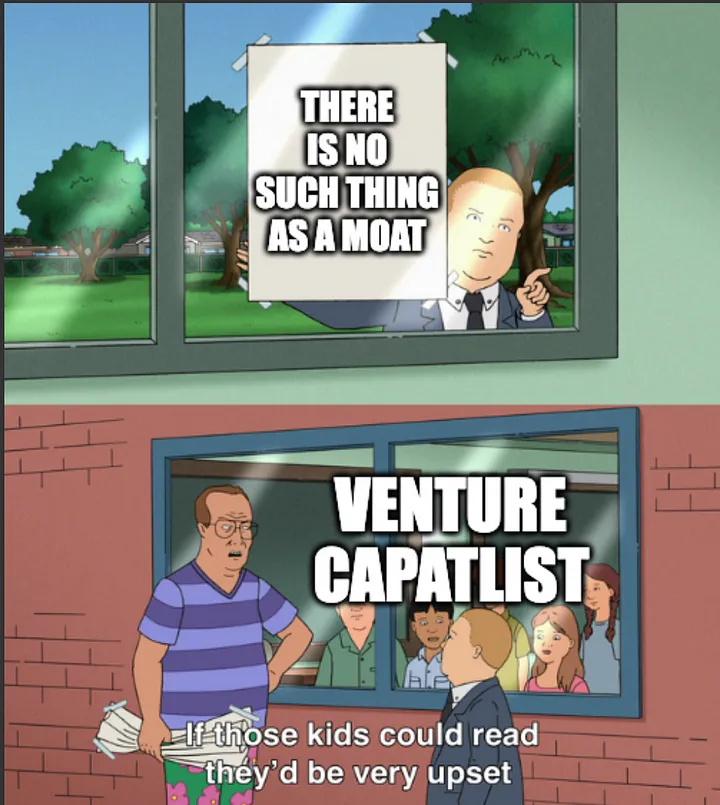
The above meme shared by a founder summarises how some founders feel about MOAT — as if it’s a VC-invented term that means nothing in the real world, but that is not the case. Let me explain.
When VCs try to assess if the following business model has, they ask whether competing with your business becomes increasingly difficult once you get a critical mass.
It’s not just the VCs; you would see any seasoned second-time founders think about it quite early on.
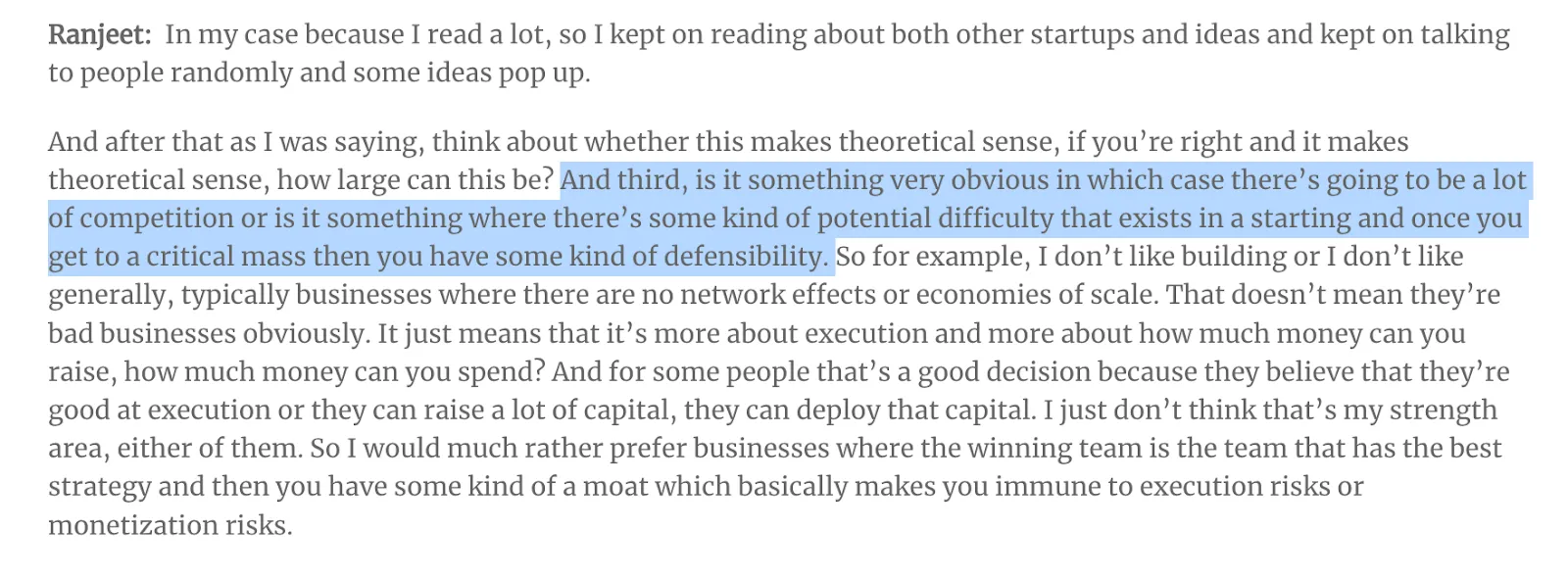
in a recent interview, Sajith Pai (Partner at Blume) asked Ranjeet (founder of Pratilipi) what was his criteria of choosing a space/business model to build, and this is what he said :
Well, you would say all this sounds great in theory, but –
Aren’t all businesses supposed to get disrupted eventually?
It’s tempting to dismiss moats because we all know that disruption is inevitable. Why build a moat when something new could always come along? The answer is simple: while no moat is permanent, they give you a point-in-time advantage. And that advantage buys you time to innovate further or extend your lead. Moats give you breathing room to sustain your business so you’re not constantly firefighting against competitors. The best moats grow as you scale your business (think about Google’s AdWords biz).
Aren’t culture/values/ability to innovate, etc, the only moat?
This is a 40-year-old debate in corporate strategy, on which Harvard Business Review has written a great article that concludes that this debate will not end any time soon.
What makes and breaks companies is culture/value/capability to innovate, etc. (some refer to this as intangible or soft moats). Those are genuinely nonreplicable and sit at the heart of the organization. However, it’s essential to understand whether you are using these to build a business that gets increasingly difficult to compete with as it scales or if you are using them to just firefight competitors on a day-to-day basis.
Ashish Mohapatra (founder of Ofbussiness), in this podcast (in the section by should Business be Complex), explains why he doesn’t like to depend on intangible moats. He says
“While intangible moats tend to be generally hard to sustain or tend to break at scale, they can also make you overly dependent on execution intensity, which is not a place he wants to be.”
I would add that if culture/values, etc, are the only moats that bring in huge keyman-ship risk — since most of it would be a reflection of the person leading the organization (which is not a place any investor/founder wants to be in, especially at the scaled up stage)
2.1 Common Types of Moats We See These Days
Let’s break down some common types of moats and how to think about them:
Product/Experience moat:
- In a blog titled “Generative AI companies have MOATs eventually,” Brandon Glenklen argues that all GEN AI companies could eventually build moats based on iterative improvements they make to the product based on accumulated user feedback over some time; this is precisely what we discussed the section on competing with Open AI, while I agree with him mostly there are two caveats I want to call out:
- This will be significantly more problematic if you are in the high-competition zone because the time to get to PMF and build the moat layer becomes significantly lower.
- Ensure it’s not a generic use case that can be served well with the next-generation LLM or, eventually, AGI.
Distribution moat:
- This has to be one of the moats; you must think of defendable ways of acquiring consumers, given how performance marketing costs have increased. Ideally, you need more than just a distribution moat because that has now become table stakes.
Brand Moat:
- Is a large portion of your customer base likely from word-of-mouth? This is critical in industries where personal recommendations, such as healthcare or SaaS, drive product discovery. However, this may not apply to all industries. For instance, in AI-powered English language learning, users are more likely to discover products through ads rather than seeking referrals or advice from peers..
Data moat:
- The founder’s argument goes like this: We have this initial set of data, which we used to make this recommendation engine and get some customers, giving us more data. More data means better recommendations mean more customers, which again means more data, but this is hardly true. We would have seen 100+ startups in the past month or so — apart from some niche areas like healthcare, we hardly find any data moat. The following conditions should be valid for data to be a moat.
- An extensive set of Proprietary Data should significantly improve the product/service. — More data is not always better; we have observed diminishing returns in the context of AI scaling. Therefore, understanding to what level data can enhance your product for the end users is super important below is an example of a use case in which the leverage of data is low:
- The Data moat should not erode over time — as time passes, the data shouldn’t go stale. Also, new data acquisition shouldn’t get costlier (while incremental value reduces)
- The startup should have proprietary data sources/strategies that are scalable (asset substantial enough for large-scale model training), continuous (data can be resampled over the period), diverse (adequately reflect real-world scenarios), and legally compliant.
And more often than not, the 1st condition isn’t proper, let alone 2 and 3.
At an applied Gen AI level, the most significant outcomes will come from business model innovation that will leverage the unique capabilities of Gen AI.
If you’re a founder building in Gen AI and thinking about how to differentiate and scale, I’d love to hear from you. Please reach out to me on Linkedin. I end up replying all my inbounds, or you can write to me at sauravg@capria.vc. Let’s explore how we can collaborate to build enduring companies.