Deprecated: Using null as an array offset is deprecated, use an empty string instead in /home/u876752588/domains/capria.vc/public_html/wp-content/plugins/jet-engine/includes/components/blocks-views/dynamic-content/manager.php on line 113
Models like BERT, once revolutionary, have been surpassed by newer approaches. Here’s a clear explanation of why this shift occurred, along with an overview of key Transformer architectures and their roles in modern AI applications.

Why Isn’t BERT Popular Anymore?
BERT (Bidirectional Encoder Representations from Transformers) was groundbreaking for its ability to fine-tune specific tasks like sentiment analysis or question answering. However, it had limitations:
- Task-Specific Design: BERT requires separate fine-tuning for each task, leading to complexity in real-world applications.
- Limited Versatility: Unlike GPT or other decoder-based models, BERT struggled to handle multiple tasks or generate sequential content.
- Shift Toward General-Purpose Models: From 2020 onward, the AI community leaned toward multi-task models like GPT, which handle multiple tasks with a unified architecture.
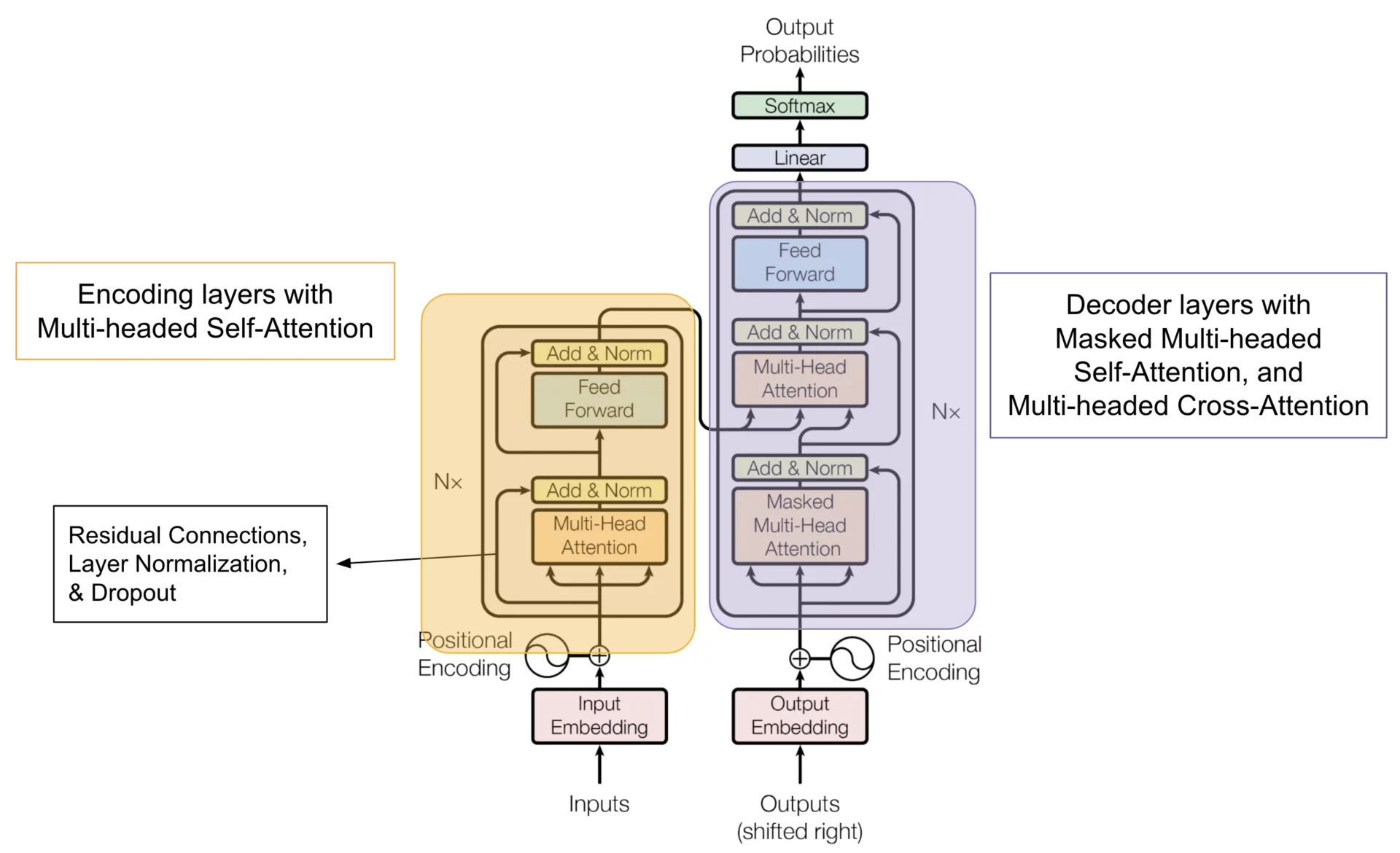
The Three Key Transformer Architectures:
- Encoder-Decoder Architecture:
- Ideal for translation tasks (e.g., converting English to French).
- Uses cross-attention to pass information from the encoder to the decoder.
- Processes the entire input context (bidirectional attention) and generates the output sequentially.
- Decoder-Only Architecture:
- Simplifies design by handling both input and output in the same module.
- Utilizes causal self-attention, where the model can only attend to past tokens.
- Best suited for text generation tasks (e.g., GPT models like GPT-3, LLaMA).
- Efficient for large-scale applications, as it generates content left-to-right, reducing complexity.
- Encoder-Only Architecture:
- Found in models like BERT, this architecture focuses on understanding input rather than generating output.
- Employs masked language modeling (MLM), which masks parts of the input and predicts them from context.
- Works well for understanding tasks (e.g., sentiment analysis, classification) but cannot generate text.
Masked LM vs. Causal Self-Attention:
- Masked Language Modeling (MLM):
- Trains the model by hiding parts of the input (e.g., “The [MASK] sat on the mat”).
- Focuses on context understanding and robustness by training the model to predict masked tokens.
- Not suitable for continuous text generation.
- Causal Self-Attention:
- Generates text step-by-step, only considering past tokens to avoid “seeing the future.”
- Powers autoregressive models like GPT, making them ideal for creative or sequential tasks like content writing or programming.
Why GPT and Decoder-Only Models Took Over:
- Unified Functionality: GPT models excel in both understanding and generating text, making them versatile for multiple use cases.
- Scalability: Decoder-only models handle massive datasets efficiently, making them more practical for real-world applications.
- Simplified Architecture: Sharing input-output parameters and skipping complex cross-attention steps reduces overhead.
Key Takeaways:
- BERT’s Encoder-Only Models: Best for tasks that need in-depth understanding but are limited in generation capabilities.
- Decoder-Only Models (e.g., GPT): Perfect for generation tasks and versatile in handling multiple contexts.
- Encoder-Decoder Models: Still relevant for translation and tasks requiring bidirectional attention but less dominant overall.
Final Insights:
Modern AI focuses more on data quality, compute resources, and training strategies than on minor architecture tweaks. The community builds on mature frameworks like GPT, ensuring efficiency and scalability while exploring innovative approaches like multimodal AI (e.g., combining text and images).
If you’re starting with AI or selecting a model, consider the task type:
- Choose encoder-only models for specific analytical tasks.
- Opt for decoder-only models for content generation or multi-task systems.
- Use encoder-decoder models for translation or specialized tasks.