Deprecated: Using null as an array offset is deprecated, use an empty string instead in /home/u876752588/domains/capria.vc/public_html/wp-content/plugins/jet-engine/includes/components/blocks-views/dynamic-content/manager.php on line 113
Variational Autoencoders (VAEs) are powerful tools for generative modeling, allowing us to generate new samples similar to a given dataset. Unlike traditional autoencoders, VAEs learn probabilistic relationships between input data and latent space representations, enabling efficient reconstruction and generation. Here’s a simplified breakdown of how VAEs work and their practical implementation.
What are VAEs?
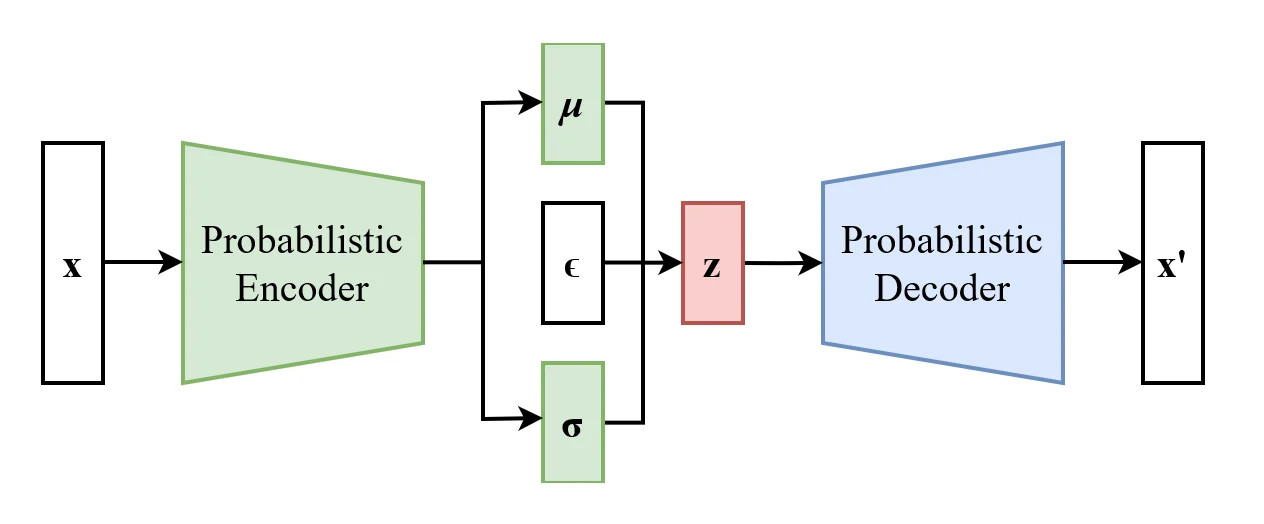
VAEs are generative models designed to produce new samples similar to the input data. They achieve this by:
- Encoding input data into a latent space with a probabilistic distribution.
- Decoding sampled latent representations back into the input space to reconstruct or generate new samples.
Key Components of VAEs
- Input Distribution (Evidence): This represents the dataset we want to model.
- Latent Space (Prior): A multivariate Gaussian distribution assumed to represent the compressed data.
- Posterior Distribution: Describes the mapping between input data and the latent space.
- Likelihood: Models the probability of reconstructing the input from the latent space.
How VAEs Work
- Encoder: Learns mean (μ) and standard deviation (σ) for the latent space distribution from the input data.
- Reparameterization Trick: Samples from the learned posterior distribution (using μ and σ) to create latent representations while enabling backpropagation.
- Decoder: Reconstructs the input data from the sampled latent representations.
Training Objective
The VAE training objective is to:
- Minimize reconstruction loss (e.g., mean squared error) to ensure accurate input reconstruction.
- Minimize Kullback-Leibler (KL) divergence to align the learned posterior distribution with the assumed prior.
This is achieved using the Evidence Lower Bound (ELBO): ELBO=Reconstruction Loss+KL Divergence
Practical Implementation Using MNIST
Here’s how to implement a VAE in Python using PyTorch and the MNIST dataset:
- Dataset Preparation:
- Load the MNIST dataset and split it into training, validation, and testing sets.
- Normalize the data for consistent processing.
- Define Encoder:
- Maps input images to latent space parameters (μ and σ).
- Define Decoder:
- Maps latent representations back to reconstructed images.
- Reparameterization:
- Use the formula z=μ+σ⋅ϵz = \mu + \sigma \cdot \epsilonz=μ+σ⋅ϵ (where ϵ\epsilonϵ is random noise) to sample latent representations.
- Loss Function:
- Combine reconstruction loss and KL divergence to train the VAE.
- Training:
- Optimize parameters to minimize ELBO using gradient descent.
Example: Generating Digits
After training the VAE, you can generate new digits by:
- Sampling random latent representations from the prior (Gaussian distribution).
- Passing these samples through the decoder to create new images.
VAEs are versatile tools for generating new data that resembles input samples. They excel in image generation, anomaly detection, and other domains requiring probabilistic modeling. Their ability to map complex data distributions makes them fundamental to modern AI tasks.
By understanding the encoder, decoder, and probabilistic relationships, you can implement VAEs for various generative modeling applications.