Deprecated: Using null as an array offset is deprecated, use an empty string instead in /home/u876752588/domains/capria.vc/public_html/wp-content/plugins/jet-engine/includes/components/blocks-views/dynamic-content/manager.php on line 113
In this article, we explore a technical approach to improving Retrieval-Augmented Generation (RAG) systems using a three-layer fixed entity architecture. This method integrates a knowledge graph with embeddings, cosine similarity, and named entity extraction to enhance retrieval efficiency and accuracy.
Architecture Overview
The three-layer architecture consists of:
- Fixed Entity Layer (FEL1): Represents predefined ontology or domain-specific entities. This layer acts as the backbone of the knowledge graph, built by domain experts or derived from a ground-truth document.
- Document Layer (DL2): Contains documents split into smaller chunks. These document nodes are linked to the fixed entities based on cosine similarity between their embeddings.
- spaCy Entities Layer (SEL3): Extracts named entities from the document chunks using the spaCy NLP library. These entities are linked back to the document chunks, further enhancing the retrieval process.
Key Components and Techniques
- Fixed Entity Layer (FEL1):
The first layer is the ontology layer, where domain-specific knowledge is represented. For example, entities such as “Albert Einstein” or “Theory of Relativity” are embedded using vector representations, and short descriptions (e.g., summaries from Wikipedia) are attached to enhance the layer’s search capabilities. These entities act as the anchor points in the knowledge graph. - Document Layer (DL2):
This layer contains the actual knowledge base in the form of document chunks. Documents are broken into smaller parts (chunks of 1,000 tokens with overlap). Cosine similarity is calculated between the embeddings of document chunks and the fixed entities in FEL1, and links are created based on a similarity threshold. - spaCy Entities Layer (SEL3):
Named entities are extracted from the document chunks using the spaCy Entity Linker. This adds an additional layer of information, enabling retrieval queries to be more refined and accurate. For example, extracting entities such as “Albert Einstein” from the documents and linking them to corresponding document nodes enhances the granularity of the knowledge graph.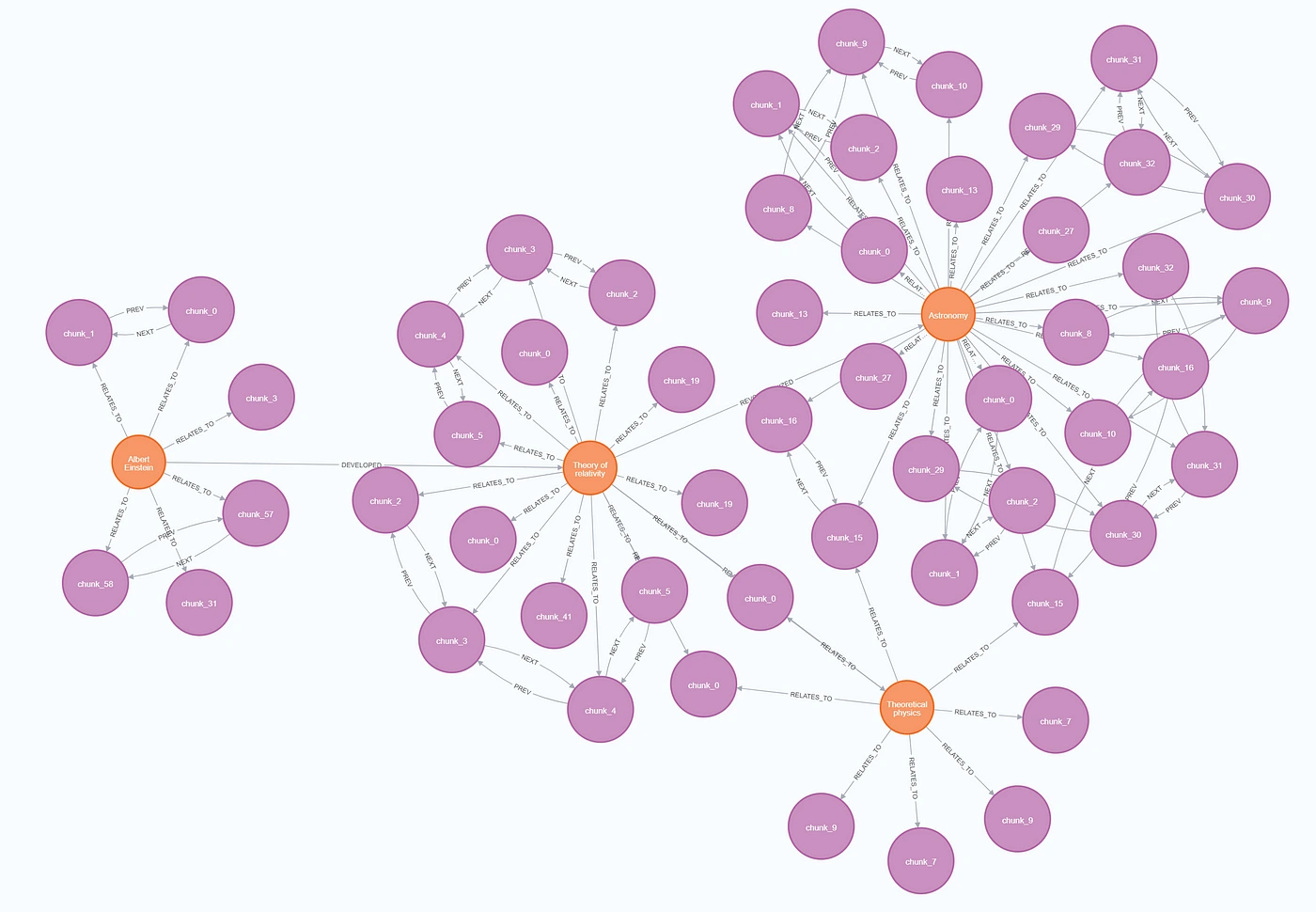
Querying the Graph
Once the three-layer architecture is established, efficient retrieval queries can be executed. By combining cosine similarity, vector-based searches, and keyword searches, you can retrieve the most relevant data points from the graph.
For example, Cypher queries (Neo4j) allow for flexible searches based on embedding similarity across the three layers. This approach ensures that the retrieval process is precise and utilizes the connections between fixed entities, document chunks, and extracted named entities.
Benefits of the Three-Layer Architecture
- Enhanced Retrieval Accuracy: The multi-layer approach refines the search process by linking fixed entities, document chunks, and named entities.
- Efficient Query Execution: Using embeddings and cosine similarity ensures that queries are executed quickly and accurately, even on large datasets.
- LLM-Free Solution: This architecture provides a cost-effective alternative to large language models by leveraging domain-specific knowledge graphs and vector databases.
This three-layer architecture for knowledge graphs optimizes retrieval in RAG systems by connecting fixed ontology entities, document chunks, and extracted named entities using cosine similarity. This setup offers a scalable and efficient method for structuring information without relying heavily on costly LLMs, making it ideal for use cases that require advanced retrieval techniques.