In the complex world of Large Language Model (LLM) optimization, we often look for complicated solutions, better training data, fine-tuning, or complex “Chain of Thought” prompting. However, researchers from Google Research have discovered a surprisingly simple technique that boosts accuracy across almost all major AI models: just say it twice.
Their paper, “Prompt Repetition Improves Non-Reasoning LLMs,” demonstrates that simply duplicating your input query can significantly improve model performance without making the AI slower.
1. What is Prompt Repetition?
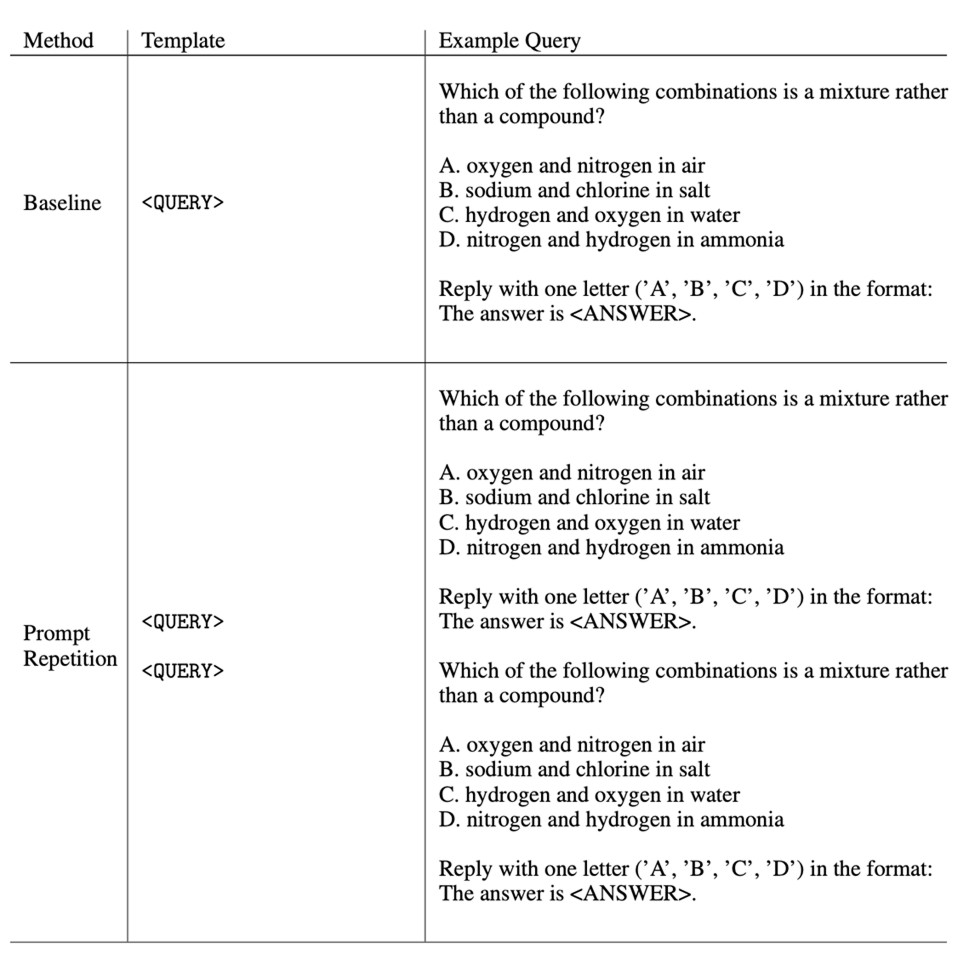
The technique is exactly what it sounds like. Instead of sending a standard prompt to an AI, you send two identical copies of that prompt back-to-back.
- Standard Input:
<QUERY> - Prompt Repetition:
<QUERY><QUERY>.
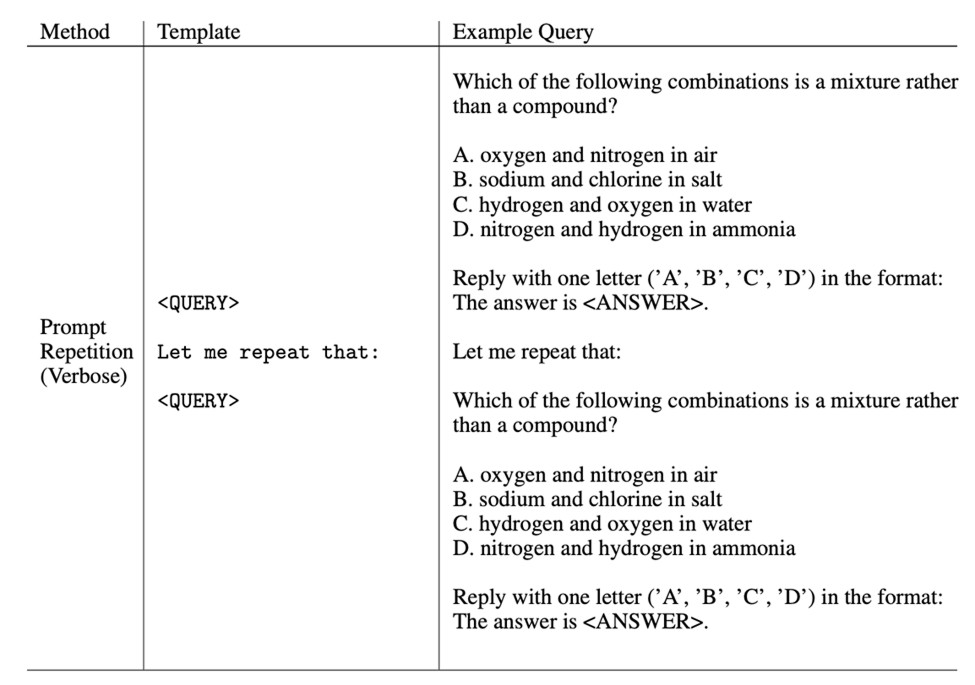
The researchers call the simplest version “Vanilla Prompt Repetition,” where the text is copied exactly with no changes. They also tested a “Verbose” version using a connector like “Let me repeat that,” but found the simple copy-paste method works just as well for most tasks.
2. Why Does This Work? (The Science)
To understand why this works, you have to understand how LLMs read. They are “causal” models, meaning they read text sequentially from left to right. A token (word) at the beginning of a sentence cannot “attend” to (or see) a word that appears at the end of the sentence.
This causes a problem for prompts where the crucial context appears after the question (e.g., “Answer this question based on the text below…”).
The Logic of Repetition: By repeating the prompt, you change the model’s perspective. When the model processes the second copy of the prompt, it can “look back” at the first copy. This allows every part of the prompt to be connected to every other part, simulating bidirectional attention.
3. The Results: Zero Losses
The researchers tested this method on 7 popular models, including GPT-4o, Gemini 2.0 Flash, Claude 3.7 Sonnet, and Deepseek V3. The results were definitive:
- Consistency: The technique won 47 out of 70 benchmark tests and lost zero times.
- Universal Gain: Accuracy improved for every model tested.
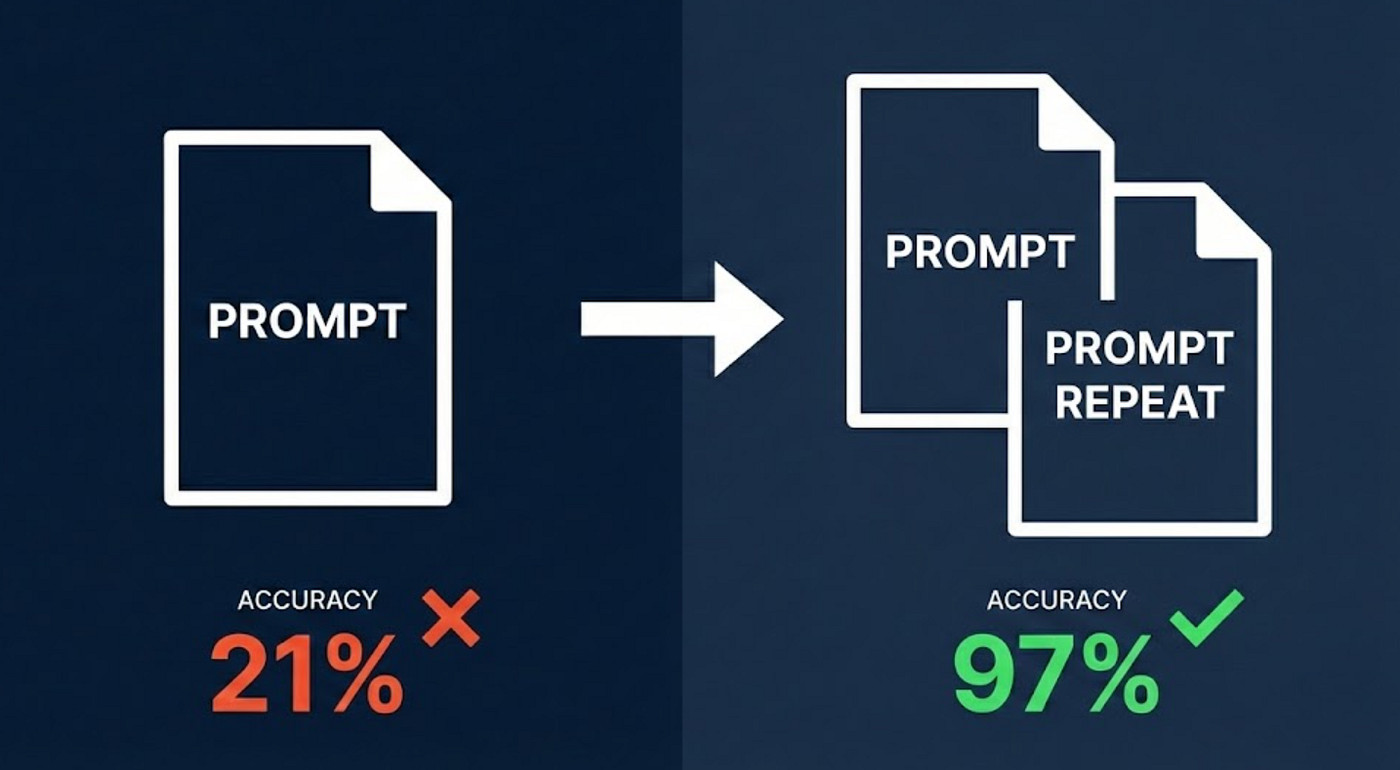
- Massive Gains on Specific Tasks: In a test called “NameIndex,” where the AI had to find the 25th name in a list of 50, the Gemini 2.0 Flash-Lite model improved its accuracy from 21.33% to 97.33% simply by using prompt repetition.
4. The “Free Lunch”: No Extra Latency
Usually, making a prompt longer makes the AI slower. However, the researchers found that prompt repetition is practically “free” in terms of wait time.
- Prefill vs. Generation: Repetition only increases the “prefill” stage (reading the prompt), which modern hardware processes in parallel very quickly.
- Output Speed: It does not increase the time the AI takes to generate the answer (latency), nor does it make the AI ramble or produce longer answers.
5. When Should You Use It?
This technique is a “default” upgrade for standard tasks, but there is one major exception.
- Use it for: Standard queries, multiple-choice questions, reading comprehension, and tasks requiring attention to detail (like finding data in a list).
- Skip it for: Tasks where you are already using “Chain of Thought” or asking the model to “think step-by-step.”
- Reasoning: When models use reasoning, they essentially repeat the prompt internally by breaking it down. Therefore, prompt repetition offers little to no benefit for reasoning tasks (though it doesn’t hurt).
6. Advanced Tip: The “Rule of Three”
For very difficult custom tasks, such as finding a name located physically between two other names in a jumbled list, the researchers found that repeating the prompt three times (Prompt Repetition ×3) worked even better than twice.
Conclusion
If you are building an AI application or just using ChatGPT for daily tasks, “Prompt Repetition” is a tool you should have in your kit. It requires no extra coding logic or complex instructions, just a simple copy and paste. As the paper suggests, because it has zero latency cost and high upside, this technique “might be a good default for many models and tasks”.
Examples: