Deprecated: Using null as an array offset is deprecated, use an empty string instead in /home/u876752588/domains/capria.vc/public_html/wp-content/plugins/jet-engine/includes/components/blocks-views/dynamic-content/manager.php on line 113
As the use of Large Language Models (LLMs) expands across various domains, ensuring their efficiency, security, and contextual accuracy becomes essential. The T-RAG framework integrates Retrieval-Augmented Generation (RAG) with fine-tuned models and entity detection, offering a robust solution for handling sensitive data and delivering precise responses. Here’s a detailed overview of how T-RAG works and its key components.
Understanding T-RAG
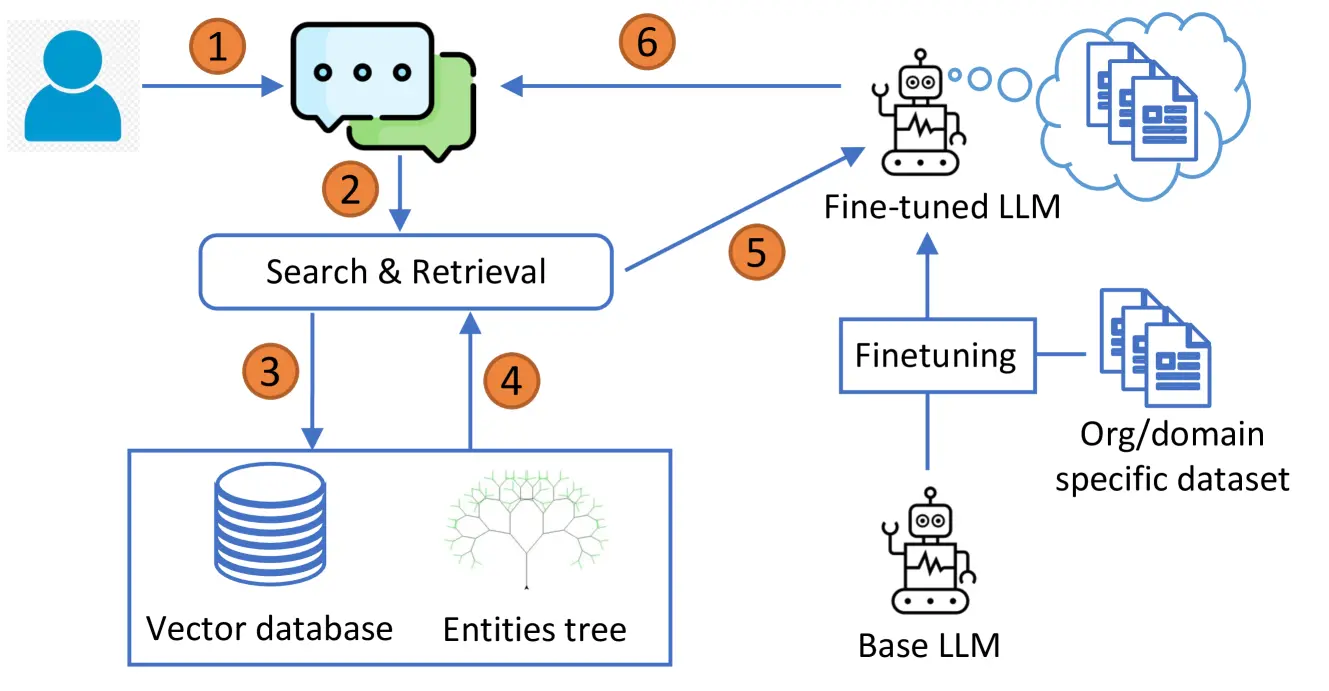
T-RAG stands for Tree-RAG, a system that combines RAG with fine-tuning and entity detection to enhance the performance of LLM applications. This framework uses an open-source fine-tuned LLM along with a vector database and an entities tree to provide contextual retrieval.
How T-RAG Works
- User Query Input: The process begins with the user inputting a query.
- Search & Retrieval: The system searches the vector database for relevant document chunks that serve as context.
- Vector Database & Entities Tree: The vector database stores document vectors, while the entities tree contains hierarchical information about organizational entities.
- Context Augmentation: If the query involves specific entities, additional information is extracted from the entities tree and added to the context.
- Fine-tuned LLM Response: The fine-tuned LLM uses contextual information to generate a response.
- Response Delivery: The generated response is delivered back to the user.
Key Components of T-RAG
- Vector Database: This stores document vectors for efficient retrieval based on user queries.
- Entities Tree: A hierarchical structure that stores details about organizational entities, enhancing context generation by providing relevant entity information.
- Fine-tuned LLM: A model fine-tuned with domain-specific datasets to provide accurate and relevant responses.
Detailed Workflow
- Query Parsing: The user query is parsed to identify relevant keywords and entities.
- Document Retrieval: The system retrieves relevant document chunks from the vector database.
- Entity Extraction: Using a tool like spaCy, the system identifies named entities within the organization.
- Context Generation: Information about identified entities is extracted from the entities tree and added to the retrieved document chunks.
- Response Generation: The fine-tuned LLM processes the augmented context to generate a detailed and accurate response.
Benefits of Using T-RAG
- Enhanced Contextual Accuracy: By integrating entity information, T-RAG ensures responses are contextually relevant and accurate.
- Data Privacy: Using open-source models and on-premise deployment reduces data leakage risks.
- Cost Efficiency: Fine-tuning and using specific models for different queries optimizes computational resources and reduces costs.
Challenges and Considerations
- Computational Resources: Implementing and maintaining the vector database and entities tree requires significant computational resources.
- Data Management: Keeping the entity tree and vector database updated with current and accurate data is crucial for optimal performance.
- Customization Needs: Extensive customization is required to tailor the system to specific organizational needs and datasets.
Conclusion
The T-RAG framework provides a comprehensive solution for enhancing LLM applications by combining retrieval-augmented generation, fine-tuning, and entity detection. By leveraging a vector database and an entity tree, T-RAG offers improved contextual accuracy, data privacy, and cost efficiency, making it a valuable tool for managing sensitive information and delivering precise responses in enterprise environments.