Deprecated: Using null as an array offset is deprecated, use an empty string instead in /home/u876752588/domains/capria.vc/public_html/wp-content/plugins/jet-engine/includes/components/blocks-views/dynamic-content/manager.php on line 113
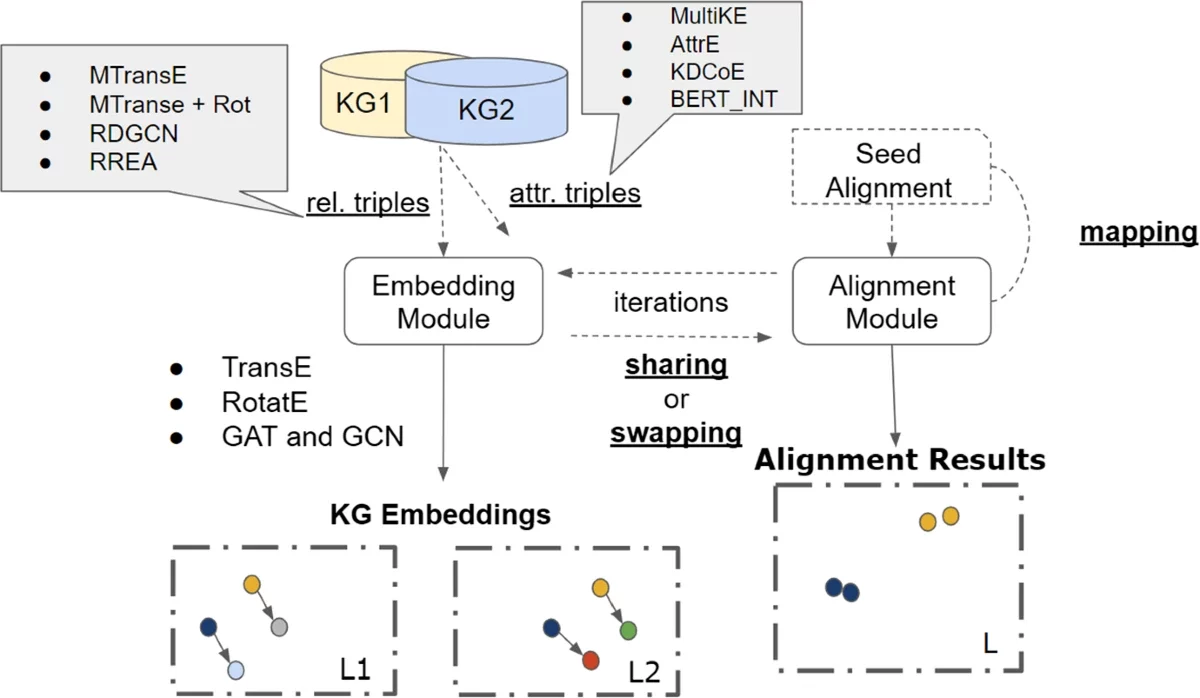
Knowledge Graphs (KGs) play a crucial role in applications such as search engines, recommendations, and AI-driven assistants. However, integrating multiple KGs requires entity alignment (EA) identifying and linking entities that represent the same real-world objects across different graphs. Embedding-based methods have emerged as an effective solution by representing entities as vectors in a shared space, making alignment more efficient.
This article summarizes key embedding-based EA techniques, including relation-based, attribute-based, and hybrid models.
Methods for Entity Alignment
1. Relation-Based Methods
These methods use the structural relationships between entities to generate embeddings.
MTransE (Multi-Translation Embedding)
- Extends TransE, which models relations as vector translations:
- h+r≈t
- MTransE aligns entities across KGs by learning transformation functions:
- Distance-based: Minimizes vector distances between aligned entities.
- Translation vectors: Maps entity vectors from one KG to another.
- Linear transformation: Uses matrix-based transformation.
Strength: Preserves KG structure.
Limitation: Fails to handle complex relationships like symmetry and inversion.
MTransE+RotatE
- Enhances MTransE by replacing TransE with RotatE, which models relations as rotations in a complex space:
- t=h o r
- RotatE can model symmetry, inversion, and composition.
- Negative sampling improves discriminative power.
Strength: Captures complex relationships.
Limitation: Computationally expensive.
2. Graph Neural Network (GNN)-Based Methods
These methods leverage graph neural networks (GNNs) to capture structural patterns.
RDGCN (Relational Dual-Graph Convolutional Network)
- Uses Graph Convolutional Networks (GCNs) to aggregate multi-hop structural information.
- Employs a dual-graph architecture:
- Primal graph: Entity-to-entity relations.
- Dual graph: Relation-to-relation interactions.
- Attention mechanism filters relevant relationships.
Strength: Captures multi-hop entity relationships.
Limitation: Requires more negative samples for training.
3. Hybrid Methods (Relation + Attribute Information)
These methods incorporate both relational and attribute-based signals for better alignment.
RREA (Relational Reflection Entity Alignment)
- Introduces a relational reflection mechanism, learning relation-specific transformations.
- Uses orthogonal transformation matrices to preserve entity structure.
- Integrates Graph Attention Networks (GATs) for dynamic weighting of relations.
Strength: Handles diverse relation types.
Limitation: Sensitive to sparsity in attributes.
Evaluation & Findings
Evaluate these methods using:
- Effectiveness Metrics: Precision, Recall, F1-score.
- Efficiency Metrics: Computation time and scalability.
- Statistical Analysis: Friedman & Nemenyi tests to compare methods.
Key Insights
- Relation-based methods (MTransE, RotatE) perform well on dense KGs but struggle with sparse attributes.
- GNN-based methods (RDGCN) leverage structure better but require more training data.
- Hybrid methods (RREA) achieve the best performance by combining structure and attribute signals.
Conclusion
Embedding-based entity alignment is critical for integrating multiple knowledge graphs. Hybrid methods like RREA outperform others by leveraging both relational and attribute-based information, while GNN-based approaches are promising for capturing complex relationships. Future research should focus on improving scalability and handling sparse attributes more effectively.