
Generative AI (GenAI) is evolving rapidly, with innovations addressing longer context handling, efficiency, and structured decision-making. Two key developments in this space are:
- Google Titans – A new neural architecture designed to improve memory and context retention in AI models.
- AI Agents & Data Products – A structured approach to using multiple AI models together for cross-domain business decisions.
This article will explain how these technologies work, their impact on AI workflows, and why they matter for businesses.
Google Titans: The Next Step Beyond Transformers?
What is Google Titans?
Google Titans is an alternative AI architecture designed to overcome the limitations of traditional Transformers, the foundation of most AI models today (including ChatGPT, Bard, and LLaMA).
Problem with Transformers: They struggle with:
- Handling long documents or sequences (e.g., legal texts, books).
- Forgetting important past details while processing new information.
- High computation cost when dealing with large datasets.
Titans introduces a Neural Long-Term Memory Module that allows AI to remember past events, prioritize important information, and discard unnecessary details, making it more efficient and context-aware.
Key Features of Titans
- Neural Long-Term Memory (LTM)
- Unlike Transformers, which rely only on short-term memory, Titans remember older information while processing new inputs.
- Helps AI make better long-term decisions.
- Memory Management System
- Uses a “forgetting mechanism” similar to human brains, so AI doesn’t waste resources on less relevant data.
- Prioritizes surprising or unexpected events, improving reasoning.
- Three Variants of Titans
- Memory as Context (MAC) – Uses memory to supplement current processing.
- Memory as a Gate (MAG) – Works alongside attention mechanisms for better efficiency.
- Memory as a Layer (MAL) – Embeds memory directly into the AI model’s architecture.
- Scalability & Efficiency
- Titans can handle over 2 million tokens, allowing AI to process entire books, scientific papers, and time-series data efficiently.
- Uses a parallelized algorithm for faster training and inference.
How Titans Works
Imagine you’re watching a long TV series:
- Short-Term Memory – You remember the details of the current episode.
- Long-Term Memory – You recall important moments from past episodes (but forget minor details).
- Forgetting Mechanism – The AI decides which details matter most and removes unnecessary information.
By combining these three functions, Titans improves how AI processes long, complex information.
How Titans are Different from Transformers
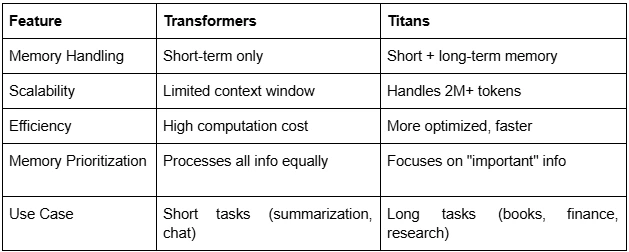
Why It Matters:
- Titans could replace or enhance traditional AI models by improving memory, efficiency, and reasoning.
- It is particularly useful for finance, legal, research, and AI-driven automation.
AI Agents & Data Products: Enabling Cross-Domain AI Decisions
While Titans improves single-model performance, AI Agents and Data Products help businesses integrate AI into multi-step workflows.
Problem:
- AI models struggle with business workflows that require multiple tasks across different domains (e.g., marketing + supply chain).
- Current AI tools work in silos, leading to disconnected insights.
Solution: Multi-Agent AI Workflows
Instead of relying on a single AI system, businesses can use multiple AI agents for different tasks.
Example: AI-driven Survey System
- Agent A – Detects sentiment in user feedback.
- Agent B – Generates follow-up questions based on responses.
- Agent C – Validates data consistency across different inputs.
Each agent communicates with others, ensuring the AI system adapts dynamically to new inputs.
How RAG (Retrieval-Augmented Generation) Helps
RAG helps AI models fetch relevant external knowledge before generating responses.
- User asks a question.
- RAG retrieves related data from structured databases or past interactions.
- The AI enhances its response using retrieved information.
- The final answer is more contextually accurate.
By integrating RAG with multi-agent systems, AI becomes smarter and more reliable for business applications.
Data Products: Connecting AI to Business Knowledge
A Data Product is a structured, reusable dataset that provides context-aware business knowledge.
Example: AI-powered Business Insights
- Marketing Data Product – Tracks ad performance and engagement.
- Supply Chain Data Product – Monitors delivery delays and stock levels.
- Finance Data Product – Evaluates budget impact and sales trends.
AI Agents + RAG + Data Products = Smarter Decision-Making
Why Multi-Agent AI is Better for Businesses
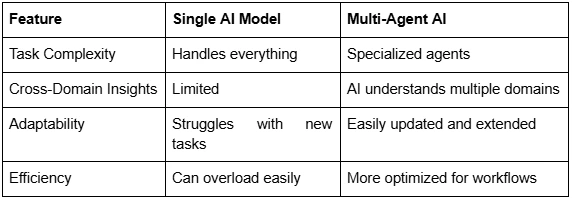
Business Benefits of Multi-Agent AI
- More Accurate AI – Each agent specializes in a specific function.
- Scalable & Modular – New agents can be added for different workflows.
- Cross-functional AI – AI can process sales, marketing, and supply chain data together.
Final Thoughts: The Future of AI Systems
- Google Titans will make AI more memory-efficient and better at long-form tasks.
- AI Agents + RAG + Data Products will enable smarter AI-driven business workflows.
- Combining these approaches will redefine AI in enterprises, improving efficiency and automation.
Who Should Care?
- Businesses that use AI for decision-making.
- Developers working on AI-powered applications.
- Researchers exploring new AI architectures.
With Titans improving AI memory and multi-agent systems enabling cross-domain intelligence, the future of AI is smarter, more efficient, and more business-oriented.