
Google researchers introduced a new method called “Infini-attention” that significantly enhances the capabilities of large language models (LLMs) by enabling them to process text of virtually unlimited length without requiring additional computational resources. This development holds promising implications for the application and efficiency of AI technologies.
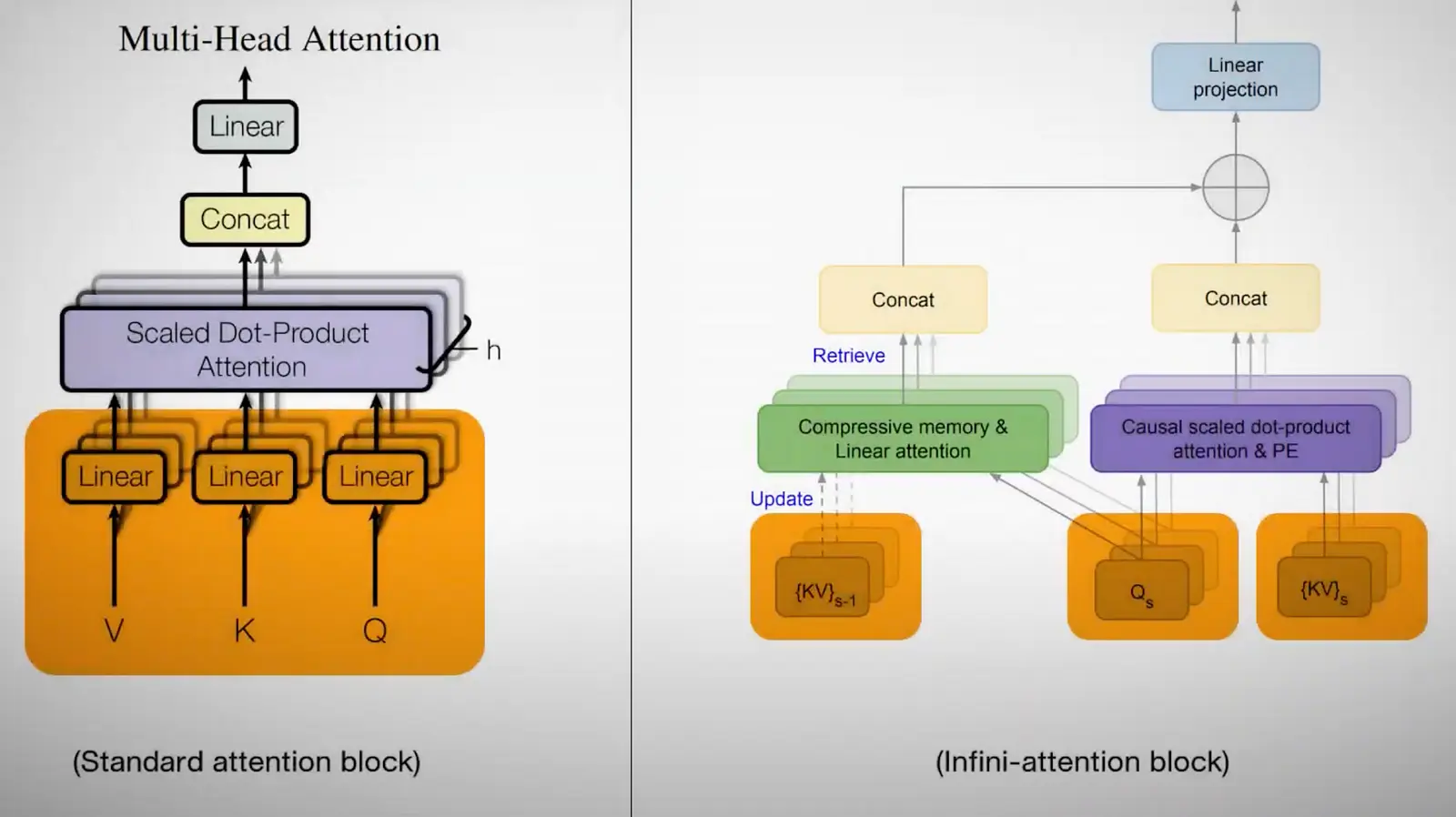
What is Infini-attention?
Infini-attention is a sophisticated technique integrated into the Transformer architecture, which is foundational to many modern LLMs like ChatGPT. Traditionally, Transformers face a challenge known as “quadratic complexity.” This means that their requirement for memory and computational power increases dramatically as the amount of input text grows. For example, doubling the text length increases the processing demand by four times.
Infini-attention addresses this issue by maintaining the standard attention mechanism but adding a “compressive memory” module. This module effectively manages longer texts by storing previous data inputs in a compressed form, which allows the model to handle extended texts while using a constant amount of memory. This setup enables the model to perform consistently well, even as the input grows exponentially.
Performance and Applications
The Google team tested this new architecture against other models in tasks requiring long text inputs. For instance, in benchmarks like the “passkey retrieval” test, where a model must recall a number placed in a long text sequence, Infini-attention outshined existing models. It demonstrated superior ability to manage extensive texts, significantly reducing memory use by up to 114 times compared to other models.
One of the significant advantages of using an LLM with an infinite context is its application in customizing AI solutions. For example, it can allow developers to incorporate extensive data directly into the AI’s prompt, making it possible to retrieve relevant information from large datasets without manually fine-tuning the model for each specific task. This reduces the complexity and resource intensity of developing AI applications, thus lowering barriers for more users to create effective AI-driven solutions.
Conclusion
While the concept of infinite context does not aim to replace existing techniques like fine-tuning or retrieval-augmented generation, it provides a complementary approach that simplifies the initial stages of AI application development. By enhancing how LLMs manage long texts, Infini-attention not only boosts performance but also broadens the potential for creative and practical AI applications across various fields.
This development is a part of the ongoing advancements in AI technology, where improving efficiency and application flexibility remains a key focus for leading tech companies like Google. As this technology evolves, it will likely become a fundamental component in the next generation of AI systems, enabling them to perform more complex tasks with greater ease and less resource consumption.