
At Capria, as a venture capital firm at the forefront of applied Generative AI, we not only collaborate with founders on GenAI proof of concept and pilot deployments but also implement our own GenAI tools, including an internal AI chatbot trained on our file system. Over time, the list of founders who want to work with us on GenAI prototypes has only grown. We’re increasingly in need of a method to organize and manage our GenAI development projects.
To tackle this, our Ops team researched different software development approaches and implemented Agile to manage our internal GenAI projects and portfolio prototypes.
What is Agile?
Agile is a product development approach that prioritizes flexibility, collaboration, and rapid learning. It involves regularly reassessing and adjusting project scopes to ensure alignment with customer needs and company goals.
Why we chose Agile
- It gives us a straightforward way to plan, execute, and evaluate to release prototype updates and continuously learn and adapt efficiently.
- It helps us stay organized and provides a way to communicate progress, which has become critical as we increase our development team size and the number of prototypes.

How we use Agile
There are several frameworks available under Agile, so we’ve chosen two lightweight methodologies to use:
- Kanban: Using Asana, we’ll create a Kanban board for each project/prototype (example) where we’ll add all feature requests & ideas and bug fixes. Each feature/bug will have a “card” with:
- Task Title: Summary of the feature, update, or fix.
- User Outcome: What is the benefit of doing this to the end user?
- Size: An estimate of how long it will take.
- Sprint: When it will be accomplished.
- Sprints: We’ll work in 2-week sprint cycles, during which we’ll choose a subset of bug fixes and new features to focus on.
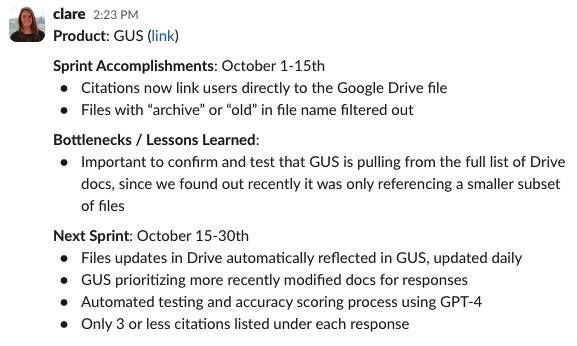
The lead for each project or prototype posts a Slack update every two weeks. They share what was accomplished in the current sprint, lessons learned or bottlenecks for items that still need to be completed, and what is queued for the upcoming sprint. We’ll also briefly meet with the group working on each project to update the Kanban accordingly. We plan to use the information to measure lead time, increasing the efficiency of product, feature, and bug-fix releases.
At Capria, we’re not just investing in the future; we’re actively shaping it. Adopting the Agile approach for managing GenAI projects exemplifies our dedication to continuous improvement and innovation. Stay tuned for future learnings from our founders and from our own internal GenAI projects!