
OpenAI has recently launched a new search feature in ChatGPT called “Deep Research,” as part of its ongoing efforts to adapt and stay ahead in the ever-changing market. This new feature does exactly what its name suggests, and more. Let’s delve deeper into this new search button and explore its potential.
In the year of 2025, Agentic AI is the topic that has been researched and talked about by the AI industry. OpenAI’s Deep Research acts like a catalyst in it. It has the ability to conduct agentic, multi-step research from the internet, which reduces laborious work hours spent searching for, and understanding any topic. Simply, you give it a prompt, and GPT will find, analyze, and amalgamate all the information for you from relevant sites across the web, ensuring you receive accurate and comprehensive answers to your questions. While processing, it provides citations of the sources it retrieves from and displays a progress bar, keeping you informed about the status of your query.
What’s Unique
OpenAI’s “Deep Research,” powered by an advanced version of the o3 model, enables ChatGPT to conduct sophisticated web searches. It goes beyond simple keyword matching by using reasoning to interpret and analyze vast amounts of text, images, and PDFs. Deep Research can adapt its search strategy dynamically based on the information it encounters, performing multi-step investigations and synthesizing findings into comprehensive summaries. This capability significantly advances Agentic AI, automating complex research tasks and providing users with valuable, well-sourced insights.
How to use deep research?
- To access the Deep Research option, locate it below the search bar and click on it.

- Then, clearly specify your research requirements in the provided space. To further enhance your research, you have the option to attach any relevant content or files that you may have.
- Once you have provided the necessary information, allow the system some time to conduct the research. This duration can vary typically between 2 minutes to 10-15 minutes, depending on the complexity of your prompt and the size of the attachments.
- As the research progresses, you can conveniently track its advancement in the right panel. It displays real-time updates on the number of resources that have been viewed and referenced for your query, along with the relevant links and the overall progress towards completion.
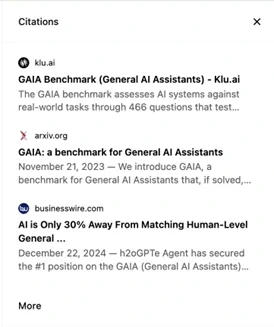
A Sample of Research Progress Bar
- Upon completion of the research, you will receive a comprehensive and detailed report that addresses your specified research needs.
How does it work?
- Advanced Training with Reinforcement Learning
– Trained on difficult browsing and reasoning tasks, Deep Research learns to navigate vast areas of information, adjusting strategy in real time to locate the most helpful data. - Strategic Multi-Step Execution
– Rather than responding directly, the model plans and executes a search path, backtracking when necessary and dynamically optimizing queries for accuracy. - File Analysis and Data Visualization
– Users can upload data sets, spreadsheets, or files, which the AI reads, summarizes, and extracts the most important findings from.
– It also has Python-based graphing tools to efficiently visualize findings.
- Cited, Verified Responses
– Deep Research provides accurate citations and direct references, as opposed to regular AI-generated content, to ensure credibility and transparency. - Benchmark-Driven Performance
– Deep Research attains better levels of accuracy, reasoning, and structured problem-solving in AI research by surpassing real-world evaluation benchmarks.
Performance Evaluation
Humanity’s Last Exam (HLE): It is a difficult benchmark to test AI models on expert-level subjects in mathematics, linguistics, rocket science, and social sciences. With over 3,000 multiple-choice and short-answer questions, HLE presents a real-world test of AI performance outside the realm of traditional benchmarks.
Among the tested models, OpenAI’s Deep Research model achieved a record-breaking 26.6% accuracy, significantly outperforming other leading AI models. The results highlight Deep Research’s ability to dynamically browse sources, analyze data, and reason effectively, setting a new standard for AI-driven research.
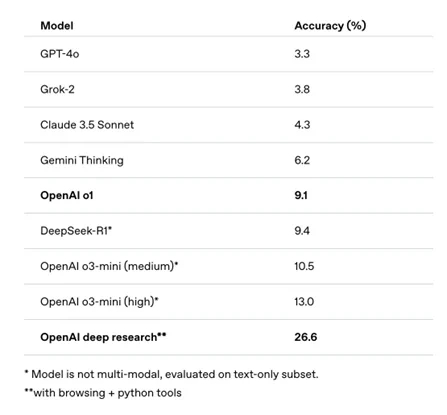
The above image shows the Accuracy comparison of various LLMs
GAIA: GAIA (General AI Assistants) is a benchmark that evaluates AI on real world tasks like reasoning, web navigation, tool use, and multi-modal processing. Developed by Gregoire Mialon and team, it comprises 466 easy human questions tough for AI.
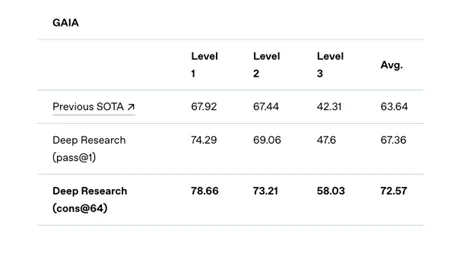
The performance of deep research on GAIA
To refer to the Levels of prompt, refer to this Link.
Limitations
- Limitation: Internal evaluations indicate that the deep research feature still experiences a certain level of hallucination and incorrect inferences, although it is significantly lower than existing ChatGPT models..
- It often lacks confidence and struggles to accurately convey uncertainty. Additionally, it may have difficulty differentiating between authoritative information and rumors.
Accessibility
- Deep Research is accessible to subscribers on ChatGPT Plus, Pro, Team, and Enterprise plans.
- If you need to know more about pricing details: Link
Conclusions
Deep Research is changing AI-powered research by delivering precise, citation-supported insights along with advanced reasoning, web browsing, and data analysis capabilities. It simplifies complex research, benefiting researchers, analysts, students, and businesses alike.
As AI continues to advance, Deep Research is establishing a new benchmark for comprehensive and reliable information retrieval, with even more features on the horizon.
See you next time!