

In Make.com workflows, code executions are necessary for occasional customizations where core modules fall short. Tools like Dumpling AI, 0CodeKit, and Custom JS bridge this gap, each with unique pricing and capabilities. Choosing the right tool is crucial for cost-effectiveness and efficiency.
For tasks involving conditional checks, or looping through data, using Python or JavaScript code becomes essential. For example, in one of the use-cases, we fetched 3 linkedin links using google search had to validate LinkedIn profile URLs, checking if a link contains “/in” (break the loop after we got 1st /in/), which can take a lot of operations in Make.com. In such cases, it can be efficiently done within a Python or JavaScript code node.
If a valid link is found in a list, a loop can be broken to optimize processing. Such scenarios, requiring data validation and conditional logic, highlight where these code execution tools are invaluable.
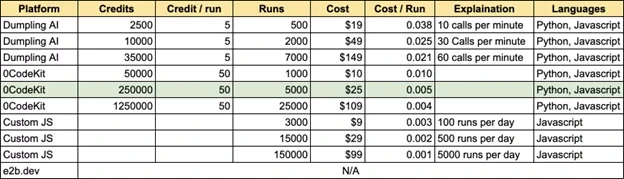
Let’s analyze pricing across plans to understand the per-execution cost of each tool:
Custom JS is the most cost-efficient tool if you’re only running JavaScript and you’re within the daily usage limits.
0CodeKit offers a great balance between cost and capability with full support for both Python and JavaScript.
Dumpling AI, while convenient and concurrency-friendly, is significantly more expensive—making it suitable only when API speed or limits matter more than cost.
Each tool provides advantages—cost, speed, or language support. Strategic tool selection for each use case, especially for those involving custom code, can yield substantial savings without compromising functionality.
Final Thoughts
Each tool offers its own advantages—cost, speed, or language support. As our automation complexity grows, being strategic about which tool we use for each use case can lead to substantial cost savings without sacrificing functionality.