In 2025, enterprises and new ventures rely on large language models (LLMs) to code, create content, and automate operations on tight budgets. With models like Claude 3.5 Sonnet (powering Cody), GPT-4o, and open-weight contenders like DeepSeek R1, choosing the right LLM is critical. This article evaluates five top LLMs for business use cases – coding, customer support, marketing, and more – offering a framework to pick the best fit. With tools like Cody and frameworks like LangChain, to leverage LLMs to scale efficiently.
Why LLMs Matter:
LLMs assists in:
- Save Time: Automate coding (e.g., Cody for MVPs) or content creation.
- Cut Costs: Reduce hiring for developers or marketers.
- Scale Smartly: Handle growing workloads with minimal overhead.
- Innovate: Build personalized customer experiences or rapid prototypes.
Criteria for Choosing an LLM
- Performance: Accuracy in coding, reasoning, or multimodal tasks.
- Cost: Free tiers, subscription fees, or hosting costs.
- Ease of Use: API access, IDE integration (e.g., Cody in VS Code), or no-code options.
- Specialization: Coding, content, or industry-specific tasks.
- Scalability: Context window size and workload capacity.
- Security: Data privacy for customer-facing applications.
Top LLMs for 2025
1. Claude 3.5 Sonnet (via Cody)
- Overview: Anthropic’s latest model, powering Cody for coding and reasoning tasks.
- Key Features:
- Excels in coding, documentation, and safety-aligned outputs.
- Cody’s VS Code integration offers context-aware suggestions.
- Free tier; Cody Pro at $9/month; API for custom agents.
- 200,000-token context window.
- Startup Use Case: A SaaS startup uses Cody to generate API code and automate documentation, saving developer hours.
- Strengths: Coding accuracy, affordability, IDE integration.
- Weaknesses: Limited multimodal support.
- Source: https://www.anthropic.com/news/claude-3-5-sonnet
2. GPT-4o
- Overview: OpenAI’s multimodal LLM for text, images, and code.
- Key Features:
- 128,000-token context window; strong in creative writing and coding.
- API via ChatGPT Plus ($20/month) or enterprise plans.
- Multimodal inputs (text, images) for versatile applications.
- Startup Use Case: An e-commerce startup generates product descriptions and ad visuals.
- Strengths: Multimodal versatility, high performance.
- Weaknesses: Higher cost, occasional hallucinations.
- Source: https://openai.com/index/hello-gpt-4o/
3. Gemini 2.5 Pro
- Overview: Google’s flagship LLM, integrated with Google Workspace.
- Key Features:
- 1-million-token context window; handles text, code, images, PDFs.
- Strong in backend coding and document summarization.
- Free tier; Advanced at $20/month.
- Startup Use Case: A legaltech startup summarizes contracts and generates reports in Google Docs.
- Strengths: Large context, Workspace integration.
- Weaknesses: Less customizable than open-weight models.
- Source: https://cloud.google.com/gemini
4. LLaMA 3.3
- Overview: Meta’s open-weight LLM, ideal for customization.
- Key Features:
- 70B parameters, 128,000-token context window.
- Excels in coding, multilingual tasks, and fine-tuning.
- Free for research; hosting costs apply.
- Startup Use Case: A healthtech startup fine-tunes LLaMA for private data analysis.
- Strengths: Flexibility, cost-effective for private deployments.
- Weaknesses: Requires infrastructure expertise.
- Source: https://ai.meta.com/llama
5. DeepSeek R1
- Overview: A 671B-parameter open-weight model, competitive with GPT-4o.
- Key Features:
- Strong in reasoning, coding, and automation.
- Cost depends on hosting; no official API.
- High performance in benchmarks like HumanEval.
- Startup Use Case: A logistics startup builds an inventory management agent.
- Strengths: High performance, cost-effective.
- Weaknesses: Limited community support.
- Source: https://www.deepseek.com/en
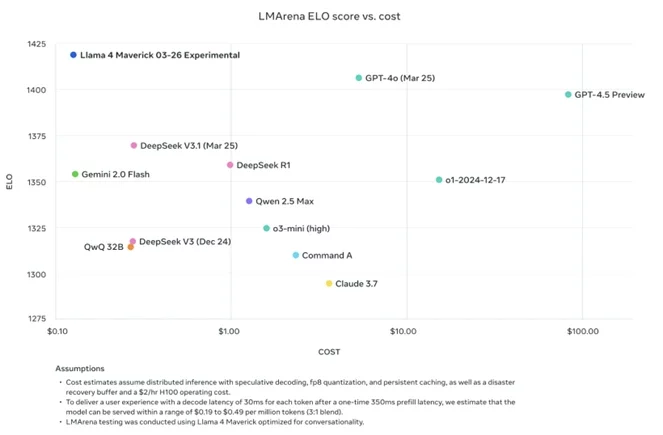
Source: https://www.llama.com/
If you want to dig deeper into more LLMs and their performance, then please visit the Leaderboard by LMArena: Link